Freetown, Sierra Leone
By Saidu Bah in Freetown, with Lucie Peytermann in Dakar
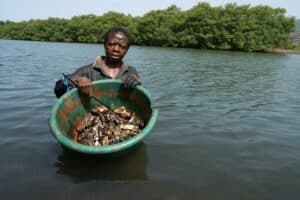
For the past 20 years, Millicent Turay has supported her family by gathering mangrove oysters near Freetown, a practice typical of this West African coastal region. But this activity, deeply rooted in Sierra Leonean culture and which has enabled generations of women to make ends meet, is now in jeopardy due to the alarming degradation of the mangrove forests caused by human expansion.
“I do this to earn enough to survive,” says the 50-year-old, whom we met in the mangrove forest, machete and gloves in hand, as she harvested the oysters growing on the aerial roots of the mangrove trees. “It’s physically demanding work that can be dangerous.”
This grueling artisanal harvesting, carried out mainly by women, requires wading at low tide—barefoot and often chest-deep—into the muddy waters and stifling heat of the mangrove to reach the rocks or mangrove trees where the wild oysters cling.
“After harvesting, we usually steam them using mangrove wood to open the shells by hand,” explains Ms. Turay, who works in the mangroves of the peninsula where the capital, Freetown, is located.
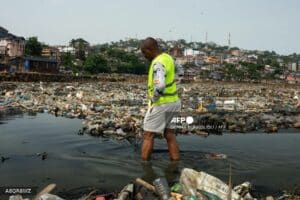
At White Man’s Bay where mangroves were completely destroyed, in some cases by “banking”, an increasingly common practice of building land into the sea with sandbags, tires and trash restoration efforts are showing quiet success. With support from the Freetown City Council, Nature for Mangroves and Plan International, replanting has brought some crabs back to the area after three years. An oyster rack has also been installed to offer alternative livelihood support for the community, particularly women, who are the primary oyster harvesters, by promoting sustainable farming methods that leave mangrove roots intact. Even as an informal waste dump continues to spill into the swamp and overwhelming risks remain across the peninsula, these small returns offer a glimpse of what community-led restoration can achieve. (Photo by Gemma Bonfiglioli / AFP)
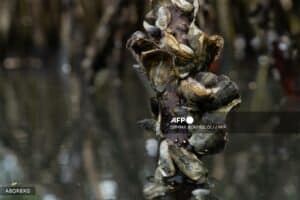
(Photo by Gemma Bonfiglioli / AFP)
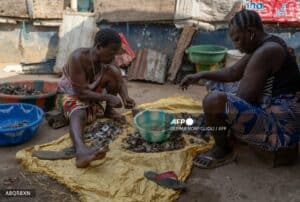
(Photo by Gemma Bonfiglioli / AFP)
– Oyster Stew –
This dish, much loved by Sierra Leoneans, is enjoyed with family or at restaurants, most often as a stew, though sometimes grilled or dried. Eating fresh oysters is more of a habit among expats or visiting tourists.
Ms. Turay says that during a good harvest season, she can earn about seven dollars (six euros) a day, which she uses to feed her family and pay her children’s school fees.
When she was a teenager, the women in her community took her to learn this harvesting practice, which is carried out in the mangroves of several West African countries.
The men, meanwhile, gather mangrove wood to use as firewood or for construction.
Sierra Leone boasts spectacular biodiversity, but its environment is under severe threat from deforestation, human activities, and the illegal encroachment of urbanization onto fragile lands—scourges that the authorities are struggling to combat.
Ms. Turay says she has noticed a decline in the harvest yield.
“Today, people come to cut down the mangrove trees,” she laments, her arms hanging limply at her sides. “They say it’s to take the land… but the mangrove is our livelihood!”
Deforestation affecting the mangrove—a wetland rich in ecosystems vital to the coastline—in Freetown is due to urbanization, firewood collection, and illegal construction, which have caused a loss of more than 25% of the mangrove cover since 1990, according to official estimates.
And the harvesting of wild oysters, through cutting and harvesting, has contributed to worsening this phenomenon.
(Photo by Gemma Bonfiglioli / AFP)
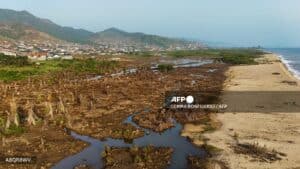
(Photo by Gemma Bonfiglioli / AFP)
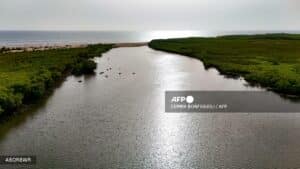
(Photo by Gemma Bonfiglioli / AFP)
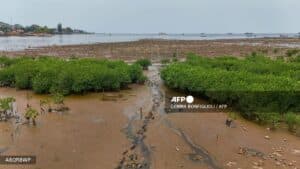
(Photo by Gemma Bonfiglioli / AFP)
– “Oyster Farm” –
Satellite images show that the area of mangroves along the coastal zone of Aberdeen, on the outskirts of Freetown, has shrunk from 537 hectares in 2017 to 458 in February 2025, according to the NGO Environmental Justice Foundation (EJF).
Aberdeen Creek is a complex of wetlands of international importance for waterbirds.
Standing in the middle of a swamp, with buildings encroaching on the area in the distance, Aminata Koroma, 32, describes the desolation around her in Cockle Bay, near Aberdeen Creek: “You see how empty it is… there used to be so many mangroves and plenty of fish…”
In recent years, the Sierra Leonean government and village communities have launched mangrove replanting initiatives to better protect the coastline and combat climate change.
Abubakarr Barrie, 28, co-founder and project coordinator of the NGO “Nature for Mangroves,” is working with residents of Kolleh Town, located on the capital’s coastline.
Abubakarr Barrie, 28, co-founder and project coordinator of the NGO “Nature for Mangroves,” is working alongside residents of Kolleh Town, located on the coast of the capital.
In the middle of the swampy water, the group is building an impressive bamboo structure, from which hang ropes strung with oyster shells and coconut husks to encourage wild oysters to attach themselves. The NGO also cultivates spat (baby oysters), creating an “oyster farm,” and restores mangroves.
These farms are intended as an alternative to the traditional method of harvesting wild oysters and its harmful effects on mangroves, explains Mr. Barrie.
The NGO aims to “reduce the pressure (from communities) on the mangrove ecosystem by introducing an alternative livelihood through these oyster farms.”
“If we do not protect our mangroves, millions of coastal residents around the world, including those in Kolleh Town, risk losing their sustainable livelihoods,” he argues.
Humaniterre with AFP