Port Sudan, Sudan
At 13, Afrah wants to become a surgeon, and the war ravaging her country—depriving millions of children of an education—has not dampened this Sudanese middle school student’s determination.
Even during the months she was out of school, displaced by the fighting that has raged since April 2023 between the army and its paramilitary rivals, “I reviewed my lessons over and over again,” says the teenager, in the Al-Hichan camp near Port Sudan.
She is one of more than 25 million children in Sudan—half the population—of whom more than 8 million are currently out of school, according to the United Nations Children’s Fund (UNICEF).
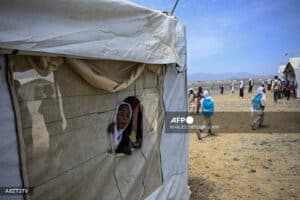
On a vacant lot within the site, tents arranged in a square serve as a school for more than 1,000 students.
Nearly a third of them first took an accelerated program offered by the UN agency to catch up on their studies.
The camp now echoes with laughter as students frolic during recess, but most have survived horrors, experienced hunger, and endured rocket fire.
– A Thirst for Learning –
Tanks, weapons, and the ever-present threat of death: in the early days, their drawings were dominated by the war
“They arrive here frightened, exhausted, and isolated, but over time we see their expressions change; they begin to adapt and come to terms with what they have been through,” explains Mira Nasser, a UNICEF spokesperson.
In a tent, children repeat after a social worker how to wash their hands, and girls recite a poem in unison.
Elsewhere, a teacher, herself a displaced person, teaches her sixth-grade class the basics of physics and chemistry, while her three-year-old son tugs at her skirt.
Awatef al-Ghaly, a 48-year-old Arabic teacher displaced from North Darfur, recalls her first days at the site, when thousands of families wandered around in a daze with their children.
“There were 60 of us teachers here; we just got to work,” she says.
They divided the students by grade level, cobbled together a schedule, and began classes with review sessions.
“It took a lot of patience; at first, the children were all sitting on the ground,” says Souad Awadallah, 52, who taught English for four decades in South Darfur before arriving in Port Sudan.
Desks now line the tents. Four students squeeze onto each bench.
Despite the difficulties, their determination is unbreakable, and the makeshift school has seen its first graduating class move from elementary school to middle school, Ms. Ghaly notes with pride.
“Even when things were tough—in the sweltering summer heat with insects everywhere—the children still wanted to learn,” she says. “Before exams, some would follow us all the way home, begging us to organize extra review sessions.”
– “Helping People” –
Their future “is at stake, and education is in itself a form of protection,” explains Mira Nasser. “Here they can at least find a semblance of normality.”
According to her, some “had even forgotten how to read and write” when they arrived at the camp.
“This war has destroyed people psychologically,” whispers Fatma, 16, who is making up for two lost years of schooling and wants to become a psychiatrist.
“My father was in the main market in Khartoum when the paramilitaries showed up and killed people. He escaped, but he still feels that pain,” she continues.
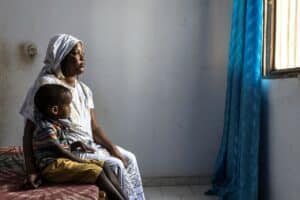
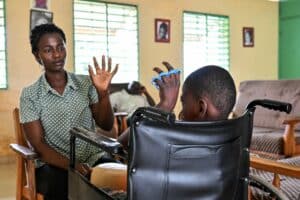
The wounds are physical as well. A young girl waves to the AFP team with her only hand: she was injured in Khartoum, and her right arm was amputated above the elbow.
Not to mention hunger: among the more than five million displaced children in Sudan, many are suffering from it, and more than 825,000 children under the age of 5 are victims of acute malnutrition.
The use of child soldiers has also been reported across the country, and widespread sexual violence against girls is preventing many of them from returning to school, even in areas safe from fighting.
For the students in Al-Hichan, the resumption of classes gives them a boost despite their longing for life as it was before.
“I miss my friends and my family; I miss my school in Khartoum—it was full of trees,” says 14-year-old Ibrahim. But he, too, has a goal: “to become a petroleum engineer.”
Another boy, Rizeq, wearing a red Manchester United jersey, plucks up his courage and steps forward toward the adults. “I want more English classes in the evening,” he says, his voice a little shaky but his chest puffed out as he makes his case.
Humaniterre with AFP