Actualité

𝐈𝐧 𝐊𝐞𝐧𝐲𝐚, 𝐀𝐧𝐭𝐬 : 𝐓𝐡𝐞 𝐒𝐮𝐫𝐩𝐫𝐢𝐬𝐢𝐧𝐠 𝐓𝐚𝐫𝐠𝐞𝐭𝐬 𝐨𝐟 𝐍𝐞𝐰 𝐏𝐨𝐚𝐜𝐡𝐞𝐫𝐬

Nairobi, Kenya

By Julie Capelle

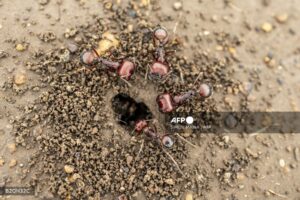
On the outskirts of Nairobi, hundreds of thousands of red and black ants scurry across waterlogged ground. Though more inconspicuous than elephants or rhinos, they too are targeted by poachers who sell them abroad.

The surprising—and largely illegal—trade in an insect with trillions of individuals worldwide has recently been brought to light by several arrests and convictions in Kenya, notably those of two 18-year-old Belgians a year ago.

These cases revealed the significant sums paid by amateur myrmecologists or enthusiasts in Europe, the United States, and Asia, who raise colonies at home to observe them.

Among the stars at the center of this trade, Messor cephalotes, an African species, is “large and bold, (…) magnificent, with vibrant colors,” describes Kenyan entomologist Dino Martins, gazing affectionately at an ant colony he has been visiting for 40 years.

These characteristics make this species “the tigers of the ant world, which is why people love them so much,” he explains to AFP, criticizing a “fad” that is somewhat “ridiculous,” like spending “a fortune on a handbag or a piece of clothing.”

Kenyan environmental protection authorities are concerned about this new trafficking and have begun to crack down

In May 2025, the two young Belgians, who were arrested in possession of nearly 5,000 Messor cephalotes queen ants hidden in test tubes and syringes, were each fined more than 6,000 euros for “wildlife trafficking.”

A Vietnamese national received the same sentence for similar offenses, while his Kenyan co-defendant, unable to pay the fine, served several months in prison.
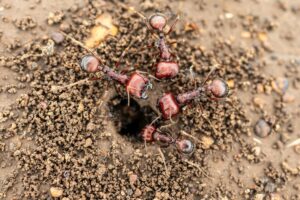


Giant African harvester ants seen next to their nest in Silole sanctuary in Kajiado on May 13, 2026.  (Photo by SIMON MAINA / AFP)
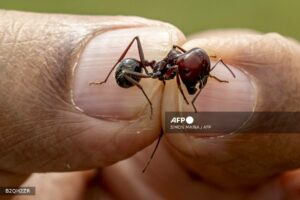
Entomologist Dr Dino Martins, holds a giant African harvester ant, in Silole sanctuary in Kajiado on May 13, 2026. Kenyan ant-expert Dino Martins gushes over the red and black insects that have become the centre of an international smuggling trade.
 (Photo by SIMON MAINA / AFP)

– 24 hours a day –

Since then, a Chinese national arrested in March at Nairobi Airport with nearly 2,000 ants in his luggage has been sentenced to one year in prison.

The court deemed a “deterrent” sentence ‘necessary’ given the “resurgence of cases” and “their harmful ecological effects.”

On several European insect-selling websites, Messor cephalotes queens—a species some sites describe as the “Holy Grail of the Messor genus”—are listed at around 200 euros but are marked as unavailable.

Supply remains abundant, however, according to Ryan, a 25-year-old Frenchman who wishes to remain anonymous. He claims to have purchased a queen, twelve workers, and “brood” (eggs and larvae, Ed.) in 2025 from an authorized site for 450 euros.

A “very reasonable” price, he says, since a queen could previously cost up to 1,000 euros.

Initially drawn to the species’ impressive size—with queens that can exceed 2 cm—Ryan says he became discouraged after failing to develop his colony and gave his ants to a friend.

Messor cephalotes, common in Kenya, is found in Africa from the Mediterranean to the Cape, according to Dino Martins.

Queens can live for decades and develop large colonies. The workers labor nearly 24 hours a day, carefully gathering the grasses they feed on, which they sort, clean, and cut up to feed their larvae, explains the Kenyan entomologist.
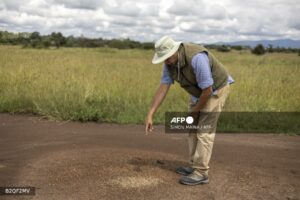
 

Entomologist Dr Dino Martins, points at a nest for the giant African harvester ants, in Silole sanctuary in Kajiado on May 13, 2026. Kenyan ant-expert Dino Martins gushes over the red and black insects that have become the centre of an international smuggling trade.
(Photo by SIMON MAINA / AFP)
Giant African harvester ants seen next to their nest in Silole sanctuary in Kajiado on May 13, 2026. 

– “Slavery” –

The collection of queens by traffickers has a “considerable” environmental impact, he laments: “It takes a colony 20 or 30 years to produce young queens,” many of whom will die during their long journey abroad.

Ants also disperse grass seeds, build structures essential for water management, and provide food for certain animals, including pangolins, he adds.

The ant trade, which began with a handful of enthusiasts, has “exploded” with the internet, notes Jérôme Gippet, a researcher at the University of Fribourg in Switzerland. The industry now includes poachers, middlemen, resellers, and buyers.

In 2017, some 500 of the 15,000 existing ant species were already being sold online, he notes. And more than 10% of these species had invasive potential, yet little attention was paid to their impact far from their native habitats.

“This trade should be banned until we have a risk assessment,” notes the researcher, who says he supports the commercialization—“with quotas”—of species that are not endangered and pose no risk of “biological invasion.”

Australia, he points out, is already doing this.

In Kenya, export permits exist, but attorney David Lusweti, who has defended several traffickers, says he has never seen one.

The judge who sentenced the two Belgians drew a parallel with the “slave trade.” “Imagine being violently expelled from your home and crammed into a container with many other people,” she said indignantly.

Humaniterre with AFP

 

Download

the online magazine

Similar items

Goma, DR Congo Photos: Jospin Mwisha In her kitchen, Julienne Mukelenge no longer fears toxic fumes or power outages. This resident

Pas de pauvreté

Éliminer la pauvreté sous toutes ses formes et partout dans le monde.

No poverty

End poverty in all its forms and everywhere.

Faim«zero»

Éliminer la faim, assurer la sécurité alimentaire, améliorer la nutrition et promouvoir l’agriculture durable.

Zero hunger

Éliminer la faim, assurer la sécurité alimentaire, améliorer la nutrition et promouvoir l’agriculture durable.

Bonne santé et bien-être

Assurer une vie saine et promouvoir le bien-être pour tous à tout âge.

Good health and well-being

Ensure healthy lives and promote well-being for all at all ages

Education de qualité

Assurer une éducation de qualité exclusive et équitable et promouvoir les possibilités d’apprentissage tout au long de la vie pour tous.

Quality education

Ensure exclusive and equitable  quality education and promote lifelong learnig opportunities for all.

égalité entre les sexes

Assurer l’égalité des sexes et l’autonomisation de toutes les femmes et les filles.

Gender equality

Achieve gender equality and empower all women and girls.

Eau propre et assainissement

Assurer la disponibilité et la gestion durable de l’eau et de l’assainissement pour tous.

Clean water and sanitation

Ensure availability and sustainable management of water and sanitation for all.

Energie propre et D’un coût abordable

Assurer l’accès à une énergie abordable, fiable, durable et moderne pour tous.

Affordable and clean energy

Ensure access to affordable, reliable, sustainable and modern energy for all.

Travail décent et croissance économique

Promouvoir une croissance économique soutenue, inclusive et durable, le plein emploi productif et un travail décent pour tous.

Decent work and economic growth

Promote sustained, inclusive and sustainable economic growth, full and productive employment and decent work for all.

Industrie, innovation et infrastructure

Construire des infrastructures résilientes, promouvoir une industrialisation inclusive et durable et encourager l’innovation.

Industry, innovation and infrastructure

Build resilient infrastructure, promote inclusive and sustainable industrialization and foster innovation.

Inégalités réduites

Réduire les inégalités entre les pays et au sein des pays.

Reduced inequalities

Reduce inequalities among and within countries.

Ville et communautés durables

Rendre les villes et les établissements humains inclusifs, sûrs, résiliants et durables.

Sustainable cities and communities

Make cities and human settlements inclusive, safe, resilient and sustainable.

Consommation et production responsable

Assurer des modes de consommation et de production durables.

Responsible consumption and production

Ensure sustainable consumption and production patterns.

Mesure relatives à la lutte contre les changements climatiques

Prendre des mesures urgentes pour lutter contre le changement climatique et ses impacts.

Climate action

Take urgent action to combat climate change and its impacts.

Vie aquatique

Conserver et utiliser durablement les océans, les mers et les ressources marines pour le développement durable.

Life below water

Conserve ans sustainably use the oceans, seas and marine resources for sustainable development.

Vie Terrestre

Protéger, restaurer et promouvoir l’utilisation durable des écosystèmes terrestres, gérer durablement les forêts, lutter contre la désertification, stopper et inverser la dégradation des sols et mettre un terme à la perte de biodiversité.

Life on land

Protect, restore and promote sustainable use of terrestrial ecosystems, sustainably manage forests, combat desertification and halt and reverse land degradation and halt biodiversity loss.

Paix, justice et institutions efficaces

Promouvoir des sociétés pacifiques et inclusives pour le développement durable, assurer l’accès à la justice pour tous et mettre en place des institutions efficaces, responsables et inclusives à tous les niveaux.

Peace, justice, and strong institutions

Promote peaceful and inclusive societies for sustainable development, provide access to justice for all and build effective, accountable and inclusive institutions at all levels.

Partenariats pour la réalisation des Objectifs

Renforcer les moyens de mise en œuvre et revitaliser le partenariat mondial pour le développement durable.

Partnerships for the goals

Strenghen the means of implementation and revitalize the global partnership for sustainable development.