Attecoube, Ivory Coast
By Bertille Lagorce
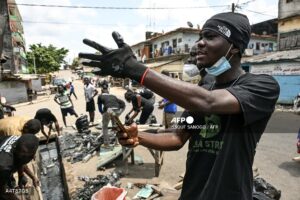
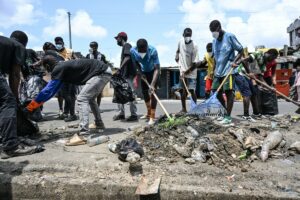
On a street in a working-class neighborhood of Abidjan, a handful of young people are scrubbing gutters overflowing with trash, near which children play barefoot: “Any country that wants to develop must first be clean,” insist these Ivorian volunteers, waging a war against filth and public reluctance.
Armed with shovels and multicolored rakes, about a dozen of them gathered one Sunday in the Attécoubé area to “set an example,” notes 22-year-old Mickaël Yao, wearing a surgical mask over his nose due to the stench in the air.
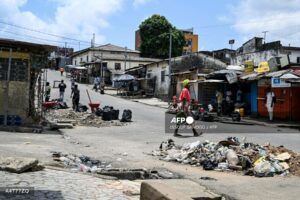
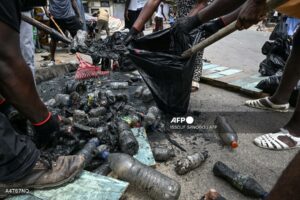
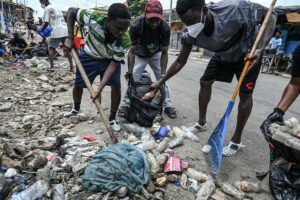
This working-class neighborhood is part of the district of Abidjan, the Ivorian economic capital with over 6 million inhabitants, which is growing rapidly and produces at least 4,500 tons of household waste every day, according to the National Waste Management Agency (Anaged).
A year ago, Mickaël Yao founded the “Clean Street” association in response to an alarming observation: “Most Ivorians throw trash on the street, and they think it’s normal,” he laments. “Our streets are not trash cans.”
Since then, he has gained recognition in Côte d’Ivoire thanks to his TikTok account, which now has nearly 50,000 followers. His videos, some of which have been viewed hundreds of thousands of times, aim to raise awareness among Ivorians about keeping public spaces clean
Plastic bottles and bags, fruit peels, leftover fried fish, and even construction debris pile up at breakneck speed in the gutters, where water can no longer flow, sometimes causing spectacular flooding during the rainy season.
Curious onlookers watch as volunteers work under the blazing sun. Soon, local youths interrupt their soccer game to lend a hand.
But that’s not always the case. “A lot of people make fun of us, asking if we’re doing this to make money,” says Mickaël Yao, who is currently taking his high school diploma exams as an independent candidate.
He says he had an epiphany while traveling to neighboring Ghana, or to Benin, in the economic capital Cotonou, where certain neighborhoods are models of cleanliness in West Africa.
“I saw that these countries were clean, so why not us?” he asks.
– “From generation to generation” –
His association now has more than sixty members. They are mainly young people, who, according to Mickaël, are the easiest to reach because in Côte d’Ivoire, older people consider it a “lack of respect” to be told what to do.
Once the cleanup is finished, the volunteers move on to going door-to-door.
Sitting in the shade in front of her house, Adjaratou Touré, 55, is preparing attiéké, a traditional Ivorian dish made from cassava. She is most concerned about the health of the neighborhood’s children
“They crawl into the gutter to retrieve their ball. Their hands get dirty, then they go buy candy and eat it. It’s a recipe for infection,” she notes.
This interior designer says she recently caught her neighbor throwing her rice gratin into the gutter. “But if you call her out on it, she’ll say, ‘Who do you think you are?’ So to avoid trouble, you just let it go.”
For many, cleanliness is a matter of education.
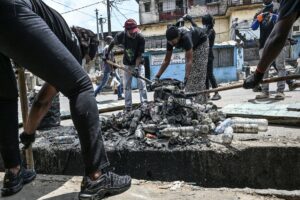
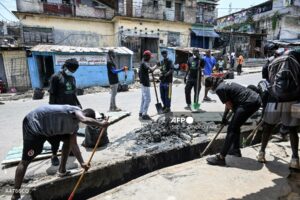
“From generation to generation, we’ll eventually adopt the right behaviors,” hopes Betty Goli, 23, a student and the association’s secretary general.
“Our voice carries further thanks to social media,” she notes.
The public, however, isn’t the only one to blame: “Garbage collectors sometimes don’t actually collect the trash; they just sweep it into the gutters,” observes a local resident.
Others point to the lack of trash cans on the streets, complaining about having to walk a long way to the nearest dumpster.
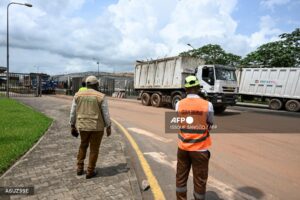
In recent years, the massive Akouédo landfill in Abidjan has been transformed into an urban park, and waste is now collected at a modern landfill on the outskirts of the city.
“There are things that need to be improved,” admits Sarrahn Ouattara, director general of Anaged, which oversees the collection and cleaning services in Abidjan, contracted out to two private companies.
But above all, she points to a “lack of civic-mindedness” and the scourge of plastic, lamenting that a 2013 decree banning plastic bags is not being enforced.
“We need to combine enforcement with awareness-raising” to bring about change, she says.
According to Mickaël Yao, Côte d’Ivoire’s international image—among investors and tourists—is also at stake. He emphasizes: “Any country that wants to be developed must first be clean.”
Humaniterre with AFP