Mekelle, Ethiopia
By Dylan Gamba
Night has fallen several hours ago over Mekelle, the capital of Ethiopia’s Tigray Regional State, but dozens of young men, carrying backpacks and suitcases, are walking in search of a bus to Addis Ababa. “It’s no longer safe here,” says Abel, 23.
Every day, by bus or plane, hundreds of people are leaving the region—Ethiopia’s northernmost—for fear that a new conflict will break out. No official figures are available.
For several weeks, soldiers from the Ethiopian federal army have been massing at Tigray’s southern border, where Tigrayan forces loyal to the TPLF (Tigray People’s Liberation Front)—the historic party that governs the regional state—have also deployed.
Abel, whose first name has been changed, fought in the ranks of the Tigrayan forces during the war that ravaged the region between 2020 and 2022 and pitted the federal government against the TPLF authorities, who had rebelled against the central government.
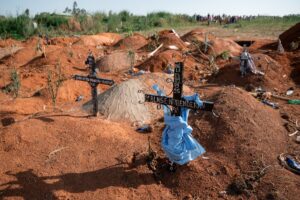
At least 600,000 people were killed, according to an estimate by the African Union, which many experts consider to be an underestimate.
The peace agreement that ended the conflict has never been fully implemented. Ethiopia and neighboring Eritrea have also recently engaged in a bitter verbal battle, which bodes ill for Tigray, whose northern border lies adjacent to Eritrea
“I’ve seen people die. I don’t want to go through that again; I don’t want the war to catch up with me once more,” Abel explains.
Several of his relatives have already left the region, he says, “there’s no one left here. Many students on my campus have already left.”
Five buses leave every evening, packed to capacity, from the bus station bound for Addis Ababa, about 700 km away. Flights to the capital are also full, despite rising fares.
– Shortages –
Tigray, which had a population of some six million before the war, is also suffering from shortages.
In Mekelle, nearly all gas stations are closed. Gasoline is being imported illegally from the neighboring Afar region. Everything goes through the black market.
At many intersections, bottles filled with gasoline are for sale. Their prices are rising rapidly. In just a few days, the price per liter rose from 300 to 430 biir (from 1.7 to 2.4 euros), a journalist noted.
For several months now, the Ethiopian government has stopped paying Tigray the federal subsidies owed to regional states. Many local government employees are no longer being paid. Banks are running out of cash.
Mekelle was largely spared by the latest conflict, unlike Chercher, a city of about 50,000 inhabitants some 150 km south of the regional capital, near the borders with the neighboring Afar and Amhara regions, where federal troops are massed.
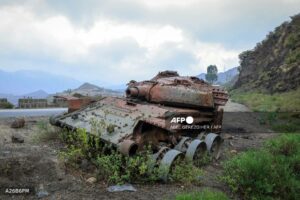
On the side of the road leading there lies a wrecked tank, overgrown with tall grass, a remnant of the fighting from the last war.
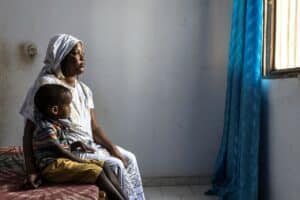
Mahlet Terefe runs a small shop in Chercher. Clashes broke out nearby in late January, and heavy artillery fire rang out, says the 23-year-old woman, who then fled for several days with her 3-year-old son.
Many young men also fled Chercher, but they haven’t returned, she continues, saying she wants to leave again “before it starts all over again.”
– “New War” –
“We’ve had enough of wars in Tigray,” she says. In addition to the latest conflict, during which she says she lost a brother, the region was also the main theater of the deadly war between Ethiopia and Eritrea from 1998 to 2000.
“There will be a new war,” laments Zinabu Gebredhin, a local administrator in Chercher, noting that federal forces are mobilizing nearby. “Their main base is about 23 km away, and they have taken up positions on hills about 10 km away,” says this TPLF member.
After governing Ethiopia for nearly 30 years, the TPLF was sidelined when current Prime Minister Abiy Ahmed came to power in 2018, and subsequently had its registration revoked.
The authorities in Addis Ababa and the TPLF are accusing each other of being responsible for the deteriorating situation.
Amanuel Assefa, the TPLF’s second-in-command, recently claimed that the federal government was preparing “to launch a war in Tigray.”
The next day, Abiy Ahmed insisted on prioritizing “dialogue,” accusing the TPLF of refusing any “compromise.”
These mutual accusations make no difference to Berhan Adhana, 50, whose small spice stall at the Chercher market is nearly deserted. “War is destructive and it ruins a country,” she remarks. “We simply want peace.”
Humaniterre with AFP