Geneva, Switzerland
By Nina Larson
Conflict and violence drove more people to flee within their own countries last year than natural disasters, with a record 32 million displacements, particularly in Iran and the Democratic Republic of the Congo.
A total of 82.2 million internally displaced people were recorded in 2025—the second-highest level ever recorded, slightly lower than the record set in 2024—according to the joint annual report by the Internal Displacement Monitoring Centre (IDMC) and the Norwegian Refugee Council (NRC), released on Tuesday.
“The figures remain at historic levels,” said Tracy Lucas, director of the IDMC, describing the new trends in displacement as a “wake-up call.”
Over the past year, the report recorded a total of 65.8 million new internal displacements, including people who had to flee multiple times.
Conflict and violence were responsible for 32.3 million of these displacements—a 60% increase from 2024—while 29.9 million were caused by storms, floods, and other disasters. This is the first time that conflict has surpassed disasters as the primary cause of internal displacement.
“We have never recorded such a staggering number of conflict-related displacements,” Ms. Lucas emphasized.
– “Global Collapse” –
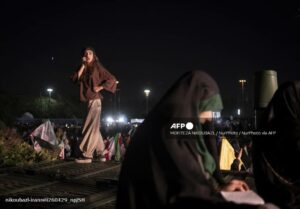
These displacements remain highly concentrated. Iran and the Democratic Republic of the Congo (DRC) alone accounted for two-thirds of new conflict-related internal displacements (approximately 10 million each).
Furthermore, nearly half of the 68.6 million people internally displaced by conflict, spread across 54 countries at the end of 2025, were concentrated in just five countries.
Sudan, ravaged by civil war, had the highest number for the third consecutive year (more than 9 million), followed by Colombia, Syria, Yemen, and Afghanistan.
“The internal displacement of tens of millions of people reflects a global collapse in conflict prevention and the protection of civilians,” said Jan Egeland, director of the NRC, in a statement.
With new conflicts adding to the many existing crises, an increase in violence-related displacement is expected.
“Countless families are returning to destroyed homes and facing non-existent services,” Egeland emphasized, adding that “from the DRC to Sudan, Iran, and Lebanon, millions more people are being displaced, adding to already record-high levels.”
– Disaster-related displacement –
The report also notes a 35% decline in disaster-related displacement of all kinds compared to the “exceptionally high levels” of 2024, while pointing out that last year’s figures remained 13% higher than the annual average for the past decade.
As climate change intensifies, countries that were once largely unaffected are now experiencing massive disaster-related displacement, while areas that were already vulnerable remain highly exposed.
Forest fires, for example, have become a growing cause of displacement globally, accounting for nearly 700,000 displacements in 2025 alone.
The report highlights the need for massive investment in climate change adaptation.
These alarming figures come as humanitarian organizations face severe constraints, particularly due to significant cuts in international aid by the United States—historically the world’s leading donor—and other countries.
Internally displaced people, who are already less visible than refugees who have crossed a border, are particularly affected by these budget cuts.
The report also highlights a sharp decline in data collection
“Data availability has declined in 15% of the countries we monitor,” said Ms. Lucas.
“Reliable data on displacement is essential to understanding where needs and risks are highest and to ensuring that policies and resources match the scale of the challenge,” she warned.
Humaniterre with AFP