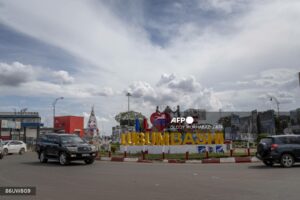
Lubumbashi, DR Congo
By Camille Laffont
Photo: Glody Murhabazi
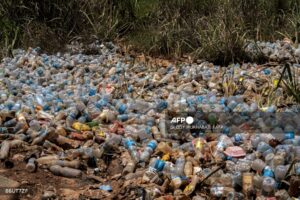
Her parched field is littered with debris carried by polluted water, and the little girl in her arms is covered in spots: in Lubumbashi, the mining capital of the DRC, thousands of Congolese people claim to be victims of toxic waste from the mining industry.
Hélène Mvubu says she has been suffering for years from the effects of contaminated floodwaters discharged by Congo Dongfang Mining (CDM), a Chinese mining company that processes copper and cobalt ore in the outskirts of the capital of Katanga province, in the southeast of the Democratic Republic of Congo (DRC).
“The food we prepare tastes bitter, our water sources are polluted,” laments the farmer as she walks across her plot in the Kamatete neighborhood, where the sugar cane is turning yellow.
World powers, notably China and the United States, are engaged in a race for strategic minerals in the DRC, whose subsoil provides more than 70% of the world’s cobalt, which is essential for the manufacture of electric batteries and weapons. But their extraction is accused of causing serious damage to the environment.
Hélène Mvubu’s field is located directly in the path of runoff from the Chinese factory, whose metal silhouette rises about 2 km away, atop a hill overlooking the residential neighborhoods of Kamatete, Kasapa, and Kamisepe
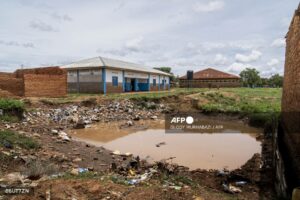
The extent of the pollution remains unknown, and CDM’s vast concession, surrounded by a concrete wall and guarded by police, is impenetrable. The only thing that is clear is that as soon as the rains come, large quantities of red water gush out of four drainage outlets dug under the enclosure.
Local residents and civil society representatives accuse CDM of taking advantage of rainy periods for years to dump wastewater from mining waste treatment.
In early November, thousands of cubic meters of reddish water once again poured out of the Chinese company’s site for two days. And this despite the fact that no rain had fallen.
This time, the flooding caused such outrage that the Congolese authorities had to take action by suspending the site’s activities and appointing a commission of inquiry. This is a rare decision in a country where mining companies, particularly Chinese ones, generally operate with impunity and complete opacity, often with the complicity of local authorities.
– “Opened the floodgates” –
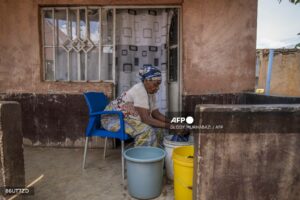
“Everyone was surprised to see the water flooding in when it hadn’t rained,” said Hortance Kiluba, a resident of Kamitete who was busy washing her clothes.
According to Joseph Kongolo, a member of the commission of inquiry and provincial coordinator of the National Human Rights Commission (CNDH), the Chinese company “was misled by the weather and opened the floodgates before the rains fell,” making the deception obvious.
However, CDM claimed that the flooding was caused by the accidental rupture of a retention basin.
According to several members of the commission of inquiry, however, pollution around the site dates back several years.
No toxicity studies on the discharged water have yet been made public, but residents say they have long been aware of its harmful effects.
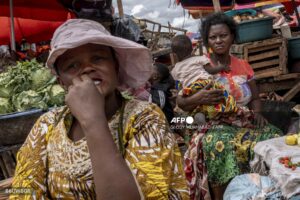
At the local market, Martiny, a fruit and vegetable seller, shows her feet and hands, which she says have been “damaged” by this “acidic” water.
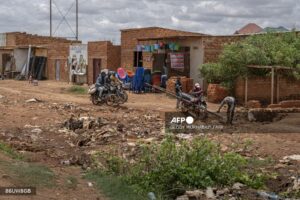
The market was completely flooded in early November. Martiny’s shipment of dried fish, soaked and inedible, is still rotting in a basin.
To calm the anger, CDM employees distributed masks and bottles of water to local residents. Their excavators are also busy rebuilding a section of road that was destroyed by the floodwaters.
“It’s just for show,” says a neighborhood leader, speaking on condition of anonymity, claiming that the Chinese company paid certain local officials to convince the communities that it was an accident.
– “Shared responsibility” –
A CDM representative denies any negligence on the part of the company, assuring that the waste “is treated on site” and that “there can therefore have been no pollution prior” to November.
The subsidiary of the Chinese multinational Zheijang Huayou Cobalt has long been in the crosshairs of local rights organizations.
Hubert Thiswaka, representative of the Institute for Human Rights Research (IRDH) and also a member of the commission of inquiry, has been fighting for several years to ensure that CDM complies with its social and financial obligations under the law: payment of mining royalties, construction of hospitals and schools, etc.
“Curiously, CDM had all the authorizations to set up at the top of this hill,” from where rainwater naturally runs down to the neighborhoods below, he says.
While the mining company has shown “contempt for basic standards” with “serious repercussions on the environment,” “responsibility is shared,” Mining Minister Louis Watum Kabamba publicly admitted at the end of the commission’s work. “Our administration should have played its role.”
Humaniterre with AFP