Bria, Central African Republic
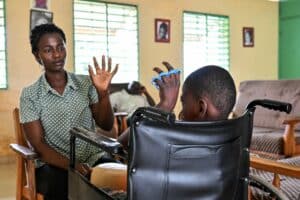
In a classroom in Bria, in the unstable eastern part of the Central African Republic, teenagers are learning to handle a needle and thread to leave behind the violence of armed groups that marked their childhood.
“It’s not easy to teach them. Some still carry the violence with them, while others are still very stressed,” observes Christophe Yonaba, their teacher.
Aged 14 to 17, his apprentice tailors are former child soldiers.
“Sometimes they just sit there, silent, and then suddenly, they get restless. As if something were blocking them,” he continues.
– “Sparkling” Diamonds –
In the east of the country, torn apart by years of armed conflict, these teenagers are trying, with the help of a local NGO, to overcome their trauma and build a future free from violence.
“They were all, at one point, captured by armed groups,” explains the 53-year-old instructor, who has been teaching them for three years.
With its 75,000 inhabitants, Bria—nicknamed “the sparkling one” because of its diamond-rich subsoil—is the capital of the Haute-Kotto prefecture, a region marked by the persistent presence of rebel groups.
The number of armed groups in the Central African Republic has declined since the height of the crisis, falling from around 20 to 14 groups recognized by the authorities. This is largely due to a series of peace agreements and disarmament programs implemented since 2012, the most recent of which was signed in July 2025.
However, certain factions and militias continue to control vast areas, especially in the east of the country, along the border with Sudan and South Sudan.
Since late 2025, fighting between the army and rebels has intensified there, leading to the displacement of tens of thousands of civilians—mostly women and children—within the country and toward the neighboring Democratic Republic of the Congo.
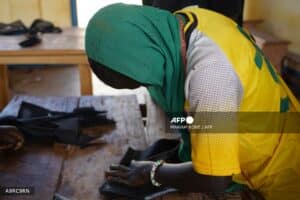
This is a way to help the teenagers, aged 14 to 17, move on from the violence they suffered at the hands of the countrys many armed groups. (Photo by Mariam KONE / AFP)

– Violence of the Past –
In the front row of the classroom, where traditional desks have given way to sewing machines, Awa (all minors’ first names have been changed, Ed.) was only 14 years old when she was abducted by members of the Unit for Peace in the Central African Republic (UPC), one of the country’s largest rebel groups.
She was held captive for about three months. She does not wish to speak about her conditions in captivity and prefers to talk about the present: “Today, I feel good. I like what I’m doing here. There are other children who have the same story as me. We help each other with the work,” the girl tells AFP, “happy” to be able to enjoy “a kind of normality.”
At 16, Amadou, who was trained as a baker by the NGO, bakes bread and doughnuts every morning in a traditional oven in his village. He spent a year and a half in the ranks of the UPC: “They didn’t ask us to take up arms, but we were there. Like servants. We did the thankless tasks, without rest. And on top of that, they spoke to us harshly, using harsh words,” he says, bringing up painful memories.
For these children, talking about the violence of the past remains a difficult task.
Rachelle, who is learning animal husbandry with Espérance, also wants to tell her story. For a year, when she was only 14, she was used as a sex slave. “They forced me to do things. In the end, I had to do it; otherwise, the consequences were severe,” she confides bravely.
Rachelle will say no more about this experience. “The thoughts are still there. I struggle not to think about them,” especially since she has no news of her mother, who was kidnapped at the same time as she was.
– Rising Demand –
In 2025, 52 students were supported by the NGO Espérance in their professional reintegration.
Active since 2016, the Central African association—funded in part by UNICEF—offers beneficiaries psychosocial support in addition to training.
And recent disarmament operations have contributed to a rise in demand: “Before, we might have received one call a month. Now, it’s every week,” explains Karl Malone, who is responsible for identifying new cases of child soldiers in the Bria region.
“This year, we received enough funding to help 100 children,” he says. But, “there are at least 117 (in total) who need help. And we can’t take care of them,” the aid worker sighs.
Like other sectors of humanitarian aid, the NGO has been affected by the decline in international funding, particularly from USAID, the U.S. development agency dismantled shortly after Donald Trump returned to power in the United States.
According to the latest annual report by the UN Secretary-General, the recruitment and use of children by armed forces and groups remains the most common violation of children’s rights in the Central African Republic, accounting for 65% of reported cases.
According to UNICEF, approximately 2,000 Central African children are still being used by armed groups.
Humaniterre with AFP