Khartoum, Sudan
By Bahira Amin with Ibrahim Abdallah in Tawila
Photos by KHALED DESOUKI
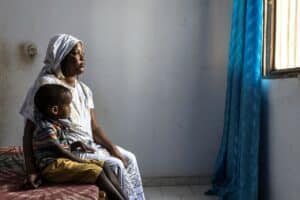
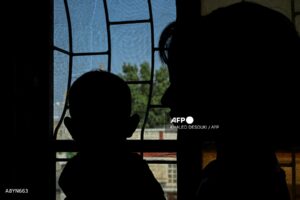
Nesma* plays tenderly with her baby on her lap. He has his mother’s eyes and smile but nothing of his father, one of the three paramilitary fighters who gang-raped her two years ago in Khartoum.
“I saw their faces. I remember them very well,” says the 26-year-old college graduate, who has met several rape victims across war-torn Sudan.
Little Yasser is one of thousands of children born as a result of rape since fighting began between the Sudanese army and the Rapid Support Forces (RSF) paramilitary group in April 2023.
Nesma had fled the Sudanese capital with her family at the start of the war. A year later, she had to return to retrieve official documents.
There, amid the factories north of Khartoum, RSF fighters stopped her bus, ordered the passengers to get off, and separated the men from the women.
Nesma was assaulted by three attackers before losing consciousness. “I came to the next morning. One of the bus passengers was lying on the ground, shot dead.”
Her account matches the modus operandi of FSR fighters who, according to UN experts, have carried out systematic sexual violence in Sudan
The trauma was so severe for the young woman that she didn’t realize she was pregnant until five months later. Right up until the day before her C-section, she wasn’t sure whether to keep the baby.
“But then, I couldn’t let him go,” she confides, saying she “couldn’t bear the thought of him suffering or ending up in a bad family,” as Yasser nestles against her neck.
“It’s not my son’s fault, just as it’s not mine.”
– Silence and Shame –
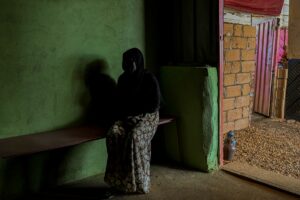
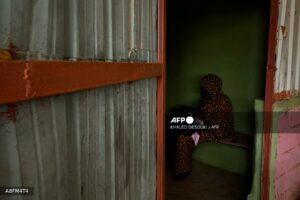
Sudan’s Minister of Social Affairs, Souleima Ishaq al-Khalifa, estimates that there are several thousand rape victims in Sudan. But the vast majority remain silent, and there is also no official record of many abortions or adoptions, which are often informal, she notes.
In Darfur, in a single city, “hundreds and hundreds of cases of young girls being raped have been recorded. Most became pregnant, and none sought medical care,” reports UN Coordinator in Sudan Denise Brown.
In Tawila, a city in North Darfur State that is home to hundreds of thousands of displaced people, Gloria Endreo, a midwife with Doctors Without Borders (MSF), has seen hundreds of survivors in two months, many of whom are pregnant as a result of rape. “Some couldn’t even bring themselves to say it,” she says
The shame that many feel in this conservative country means that most of these children are raised in secret. Victims may be rejected or even accused of colluding with the FSR.
“Families have abandoned their daughters; husbands have divorced their raped wives,” she says. “They are victims of a double injustice,” laments Reem Alsalem, the UN Special Rapporteur on violence against women and girls.
In this conflict, rape is used as a weapon “of war, domination, destruction, and genocide to tear apart the social fabric and alter its composition,” she analyzes.
Mass rapes were already among the crimes against humanity attributed to the Janjaweed—Arab militias from which the FSR emerged—in the early 2000s.
– Three times –
In a straw hut in Tawila, Hayat, 20, tries to put her four-month-old son to sleep. She hopes for “a better future” for him: “I don’t want him to grow up like us,” she whispers.
Hayat was raped while fleeing the Zamzam camp near El-Fasher, the last major city in North Darfur to fall to the FSR in October 2025.
During their attack on the camp, which housed half a million people, the paramilitaries are accused of killing more than 1,000 civilians and carrying out a campaign of systematic rape targeting women from non-Arab ethnic groups, according to the UN.
Halima, 23, has endured this ordeal three times: she was raped as a teenager by herders while working in the fields, then again in 2022 on the road to Zamzam, and finally when she escaped from the camp.
The young woman is raising her two children, born from the first two rapes, but avoided a third pregnancy thanks to emergency contraception prescribed by doctors.
In Tawila, AFP met several survivors who were raped and became pregnant during the fall of El-Facher, during which paramilitary forces killed at least 6,000 people in three days.
Like Rawia, 17. She saw the FSR kill half of the people she was fleeing with. Then “three of them stripped us of all our belongings and raped us.” She is five months pregnant.
Alia, 25, was forcibly taken back to El-Fasher with four other young women, held captive for six weeks, “until we fled in the middle of the night.” She then had a miscarriage.
Magda, 22, lost her husband in a rocket attack and then saw her brother shot dead on the road to Tawila. She was raped five months ago.
“When I found out I was pregnant, I told myself: ‘If I lose this baby, it will be one more person to mourn. But if he lives, it’s fate, and I’ll raise him.”
– “Motherly instinct” –
Fayha*, meanwhile, was raped by a civilian while one of her friends—a soldier who was off duty but still armed—stood guard.
“I was terrified he would shoot me,” she recalls, tears welling in her eyes, as she rocks her five-month-old baby in the sweltering heat of Khartoum.
According to the UN, sexual violence committed by the army is largely underreported out of fear of reprisals. Observers nevertheless believe that it is not comparable to the systematic rape strategy carried out by paramilitary groups.
“The FSR rape to subjugate society, displace people, and dominate; army soldiers rape because they know they will go unpunished,” explains an activist speaking on condition of anonymity.
Fayha didn’t realize she was pregnant until after her first trimester. At 30, she is discovering motherhood under these circumstances, where she must “be both mother and father.”
“Sometimes I get angry; it’s time to feed him and I’m fed up with him.” But “recently, I’ve started to feel a little more maternal instinct,” she confides.
For some who gave birth against their will, it is difficult to “show love or attention toward a child they are then forced to raise, as the child constantly reminds them of what they have been through,” says Gloria Endreo of MSF.
Fayha, like Nesma and so many others, has also had to fight to obtain a birth certificate, without which these children cannot receive healthcare, assistance, or an education.
Normally, “this shouldn’t be a problem; procedures are in place,” says Souleima Ishaq al-Khalifa, who advocated for women’s rights before joining the government.
In reality, conservative social norms and the collapse of the country’s administration complicate matters.
“What will be the legal status of these children?” worries Denise Brown, who sees this as a “long-term problem.” “How will they be cared for within families? What consequences will this have on communities?”
– An “FSR baby” –
In al-Jazirah State, southeast of Khartoum, the trauma is particularly raw.
During the paramilitary raids, young girls with lighter skin, from ethnic groups different from those of the FSR fighters, were “explicitly targeted and treated as spoils of war,” according to the women’s rights organization Siha.
Many families have left their villages for good to escape the trauma of mass rapes, forced marriages, and sexual slavery inflicted by the FSR.
When the army retook central Sudan in 2025, the government relaxed abortion laws in an attempt to mitigate the impact on society of the sexual violence committed by the FSR.
“There was a certain degree of tolerance regarding abortion, but many were unaware of this, and authorization was required. And because of social stigma, many did not come forward,” notes UN Special Rapporteur Reem Alsalem.
One volunteer confided that she had helped 26 women and girls obtain abortions. Most of them “had previously taken extremely dangerous medications.”
At Tawila, Gloria Endreo of MSF speaks of these women who were taken in and who “were bleeding after attempting clandestine abortions.”
The Minister of Social Affairs also recalls a 16-year-old girl who was forced to carry her pregnancy to term: as soon as she gave birth, the grandmother “took the child in her arms, handed it to us, and said, ‘We won’t bring this baby home from the FSR.’”
“She wanted all of this to be erased, as if nothing had ever happened,” Ms. Khalifa continues. The baby was placed with a foster family.
– “He deserves a good life” –
Other victims were forcibly married to paramilitaries and taken with them to Darfur when they retreated there. Their families could not pay the ransom to free them.
In Nyala, the capital of South Darfur, “there are dozens of girls and women whose children are now one or two years old, and they are trapped,” according to the minister
And then there are those who took advantage of the massive population displacements—11 million displaced people, according to the UN, in this war—to raise their children without anyone knowing the circumstances of their conception.
“Many no longer had the same neighbors; they were able to give birth without anyone knowing and pass the baby off as a brother or sister or as a child victim of the war whom they had taken in,” the minister explains.
The government is trying to place as many abandoned children as possible, but many are adopted informally, particularly in eastern Sudan, where taking in children in need is an established practice. Ms. Alsalem is also concerned about the “lack of follow-up and oversight.”
Since giving birth, even in the midst of depression, Nesma has never considered parting with Yasser.
Today, her son is thirteen months old. She has two goals: to care for him as best she can and to land a well-paying job thanks to her college degree.
“He deserves a good life,” she whispers, holding his hands to help him take his first steps.
* Names changed at the victims’ request
Humaniterre with AFP