Nairobi, Kenya
By Julie Capelle
On the outskirts of Nairobi, hundreds of thousands of red and black ants scurry across waterlogged ground. Though more inconspicuous than elephants or rhinos, they too are targeted by poachers who sell them abroad.
The surprising—and largely illegal—trade in an insect with trillions of individuals worldwide has recently been brought to light by several arrests and convictions in Kenya, notably those of two 18-year-old Belgians a year ago.
These cases revealed the significant sums paid by amateur myrmecologists or enthusiasts in Europe, the United States, and Asia, who raise colonies at home to observe them.
Among the stars at the center of this trade, Messor cephalotes, an African species, is “large and bold, (…) magnificent, with vibrant colors,” describes Kenyan entomologist Dino Martins, gazing affectionately at an ant colony he has been visiting for 40 years.
These characteristics make this species “the tigers of the ant world, which is why people love them so much,” he explains to AFP, criticizing a “fad” that is somewhat “ridiculous,” like spending “a fortune on a handbag or a piece of clothing.”
Kenyan environmental protection authorities are concerned about this new trafficking and have begun to crack down
In May 2025, the two young Belgians, who were arrested in possession of nearly 5,000 Messor cephalotes queen ants hidden in test tubes and syringes, were each fined more than 6,000 euros for “wildlife trafficking.”
A Vietnamese national received the same sentence for similar offenses, while his Kenyan co-defendant, unable to pay the fine, served several months in prison.
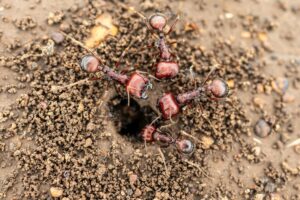
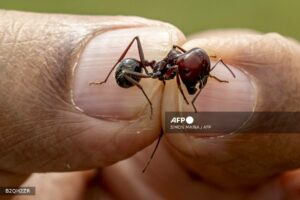
(Photo by SIMON MAINA / AFP)
– 24 hours a day –
Since then, a Chinese national arrested in March at Nairobi Airport with nearly 2,000 ants in his luggage has been sentenced to one year in prison.
The court deemed a “deterrent” sentence ‘necessary’ given the “resurgence of cases” and “their harmful ecological effects.”
On several European insect-selling websites, Messor cephalotes queens—a species some sites describe as the “Holy Grail of the Messor genus”—are listed at around 200 euros but are marked as unavailable.
Supply remains abundant, however, according to Ryan, a 25-year-old Frenchman who wishes to remain anonymous. He claims to have purchased a queen, twelve workers, and “brood” (eggs and larvae, Ed.) in 2025 from an authorized site for 450 euros.
A “very reasonable” price, he says, since a queen could previously cost up to 1,000 euros.
Initially drawn to the species’ impressive size—with queens that can exceed 2 cm—Ryan says he became discouraged after failing to develop his colony and gave his ants to a friend.
Messor cephalotes, common in Kenya, is found in Africa from the Mediterranean to the Cape, according to Dino Martins.
Queens can live for decades and develop large colonies. The workers labor nearly 24 hours a day, carefully gathering the grasses they feed on, which they sort, clean, and cut up to feed their larvae, explains the Kenyan entomologist.
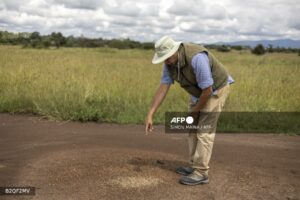
(Photo by SIMON MAINA / AFP)
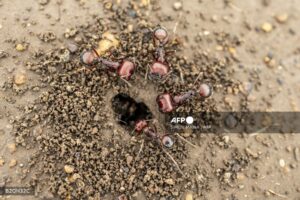
– “Slavery” –
The collection of queens by traffickers has a “considerable” environmental impact, he laments: “It takes a colony 20 or 30 years to produce young queens,” many of whom will die during their long journey abroad.
Ants also disperse grass seeds, build structures essential for water management, and provide food for certain animals, including pangolins, he adds.
The ant trade, which began with a handful of enthusiasts, has “exploded” with the internet, notes Jérôme Gippet, a researcher at the University of Fribourg in Switzerland. The industry now includes poachers, middlemen, resellers, and buyers.
In 2017, some 500 of the 15,000 existing ant species were already being sold online, he notes. And more than 10% of these species had invasive potential, yet little attention was paid to their impact far from their native habitats.
“This trade should be banned until we have a risk assessment,” notes the researcher, who says he supports the commercialization—“with quotas”—of species that are not endangered and pose no risk of “biological invasion.”
Australia, he points out, is already doing this.
In Kenya, export permits exist, but attorney David Lusweti, who has defended several traffickers, says he has never seen one.
The judge who sentenced the two Belgians drew a parallel with the “slave trade.” “Imagine being violently expelled from your home and crammed into a container with many other people,” she said indignantly.
Humaniterre with AFP