Actualitรฉ

๐ˆ๐ง ๐†๐ก๐š๐ง๐š, ๐จ๐ง๐ž ๐ฆ๐š๐ง’๐ฌ ๐ซ๐š๐œ๐ž ๐ญ๐จ ๐ฌ๐š๐ฏ๐ž ๐œ๐ซ๐ข๐ญ๐ข๐œ๐š๐ฅ๐ฅ๐ฒ ๐ž๐ง๐๐š๐ง๐ ๐ž๐ซ๐ž๐ ๐Ÿ๐ข๐ฌ๐ก

Apam, Ghana

As dawn breaks over Ghana’s Atlantic coast, artisanal fishing boats return to shore with last night’s catch — baskets of snapper, crabs, rays and a distinct-looking fish locals call “esene”.
Once abundant along Ghana’s shores, esene, or guitarfish — with the flattened body of a ray and the tail of a shark — have become increasingly difficult to find.

For conservationist Issah Seidu, 36, every landing is a reminder that time is running out to save the endangered species.

After studying terrestrial wildlife, he visited coastal fishing communities in 2018 and encountered what scientists describe as one of the world’s least-known conservation crises.

“We came to these communities and saw piles of sharks, rays and guitarfish being landed without any thought about conservation,” Seidu told AFP.

“That was the moment I realised somebody had to do something,” said the wildlife biologist, who never dreamt of a career revolving around the sea.

Guitarfish — relatives of both sharks and rays — are among the world’s most threatened marine fish, red-listed as “critically endangered” by the International Union for Conservation of Nature (IUCN).

Their meat is a delicacy widely eaten locally, while their fins command high prices in international markets.

Across west Africa, populations have collapsed.

Sawfish may have already disappeared from Ghana’s waters and wedgefish, another close relative, have become increasingly scarce.

Seidu fears guitarfish could be next.
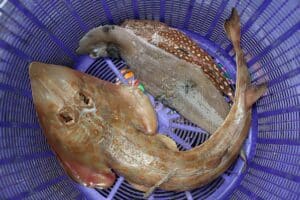
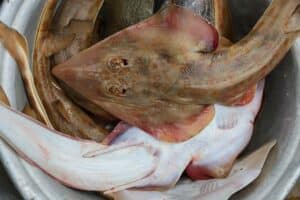
Freshly caught guitarfish are placed in a bucket at the fishing harbour in Apam, on June 22, 2026. Guitarfish — relatives of both sharks and rays — are among the world’s most threatened marine fish, red-listed as “critically endangered” by the International Union for Conservation of Nature (IUCN). In a historic first, Ghana in April designated a 703-square-kilometre (271-square-mile) stretch of the Atlantic ocean as a marine protected area (MPA) to be co-managed by coastal communities and national government. (Photo by Nipah Dennis / AFP)
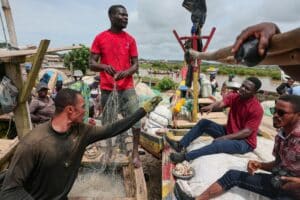
Dr Issah Seidu, Founder of AquaLife Conservancy (2nd R), interacts with fishermen at the fishing harbour in Apam, on June 22, 2026. Guitarfish — relatives of both sharks and rays — are among the world’s most threatened marine fish, red-listed as “critically endangered” by the International Union for Conservation of Nature (IUCN). In a historic first, Ghana in April designated a 703-square-kilometre (271-square-mile) stretch of the Atlantic ocean as a marine protected area (MPA) to be co-managed by coastal communities and national government. (Photo by Nipah Dennis / AFP)
Freshly caught guitarfish are placed in a bucket at the fishing harbour in Apam, on June 22, 2026. Guitarfish — relatives of both sharks and rays — are among the world’s most threatened marine fish, red-listed as “critically endangered” by the International Union for Conservation of Nature (IUCN). In a historic first, Ghana in April designated a 703-square-kilometre (271-square-mile) stretch of the Atlantic ocean as a marine protected area (MPA) to be co-managed by coastal communities and national government. (Photo by Nipah Dennis / AFP)

– Winning over fishermen –


The biggest challenge has been persuading fishermen to stop catching one of their most valuable species.

Seidu’s NGO AquaLife Conservancy has helped boost knowledge about conservation.

And instead of simply asking fishermen to stop, it has helped develop snail farming as an alternative livelihood.

Today, rows of giant African snails crawl inside wooden pens in Adjoa, a coastal community where fishing families are testing the new source of income.

“The fishermen themselves selected snail farming,” said Seidu — and they cannot meet the demand.

Edward Afful, a fisherman of 20 years, says shrinking catches have left many crews struggling to recover the cost of fuel for their boats.

He now raises snails alongside fishing.

“If we had started this years ago, everyone would have benefitted,” he said.
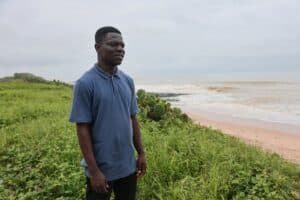
Dr Issah Seidu, Founder of AquaLife Conservancy, poses for a photograph in Adwoa, in the western region of Ghana on June 23, 2026. Guitarfish — relatives of both sharks and rays — are among the world’s most threatened marine fish, red-listed as “critically endangered” by the International Union for Conservation of Nature (IUCN). In a historic first, Ghana in April designated a 703-square-kilometre (271-square-mile) stretch of the Atlantic ocean as a marine protected area (MPA) to be co-managed by coastal communities and national government. (Photo by Nipah Dennis / AFP)
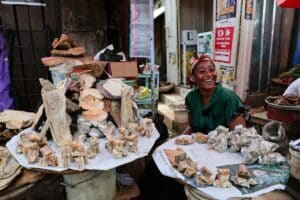
A woman sits near pieces of guitarfish are displayed for sale at a market in Mankessim, on June 22, 2026. Guitarfish — relatives of both sharks and rays — are among the world’s most threatened marine fish, red-listed as “critically endangered” by the International Union for Conservation of Nature (IUCN). In a historic first, Ghana in April designated a 703-square-kilometre (271-square-mile) stretch of the Atlantic ocean as a marine protected area (MPA) to be co-managed by coastal communities and national government. (Photo by Nipah Dennis / AFP)

– Locals map the sea –


In a historic first, Ghana in April designated a 703-square-kilometre (271-square-mile) stretch of the Atlantic Ocean as a marine protected area (MPA) to be co-managed by coastal communities and national government.

“There are very unique species in the area that need to be protected, including the guitarfish,” said University of Ghana’s Francis Nunoo, a professor in fisheries science.

As policymakers in the capital put the finishing touches to the design and implementation of the national MPA, Seidu and local fishermen in Adjoa and Apam, several hours’ drive from Accra, are already showing what it can look like.

They have created their own “locally managed marine area”.

Seidu equipped fishermen with GPS trackers to identify where guitarfish gather and spawn.

Together they have mapped about 15 square kilometres of critical habitat.

“The fishermen are the custodians of these places,” Seidu said. “They know where the species congregate and where the nursery grounds are.”

In Apam, trader Evelyn Akorful, 41, has seen catches fluctuate with the seasons but has nevertheless noticed a steady decline over the years.

“Now we don’t get as much as before,” she said, blaming destructive fishing methods, particularly the use of lights at sea, for the depleting stocks.

For her family, every catch counts. Sales of guitarfish, crabs and other species help pay school fees and household expenses.

“If we don’t get one fish, we try another. We survive by mixing everything,” she said, dangling two freshly caught guitarfish from her hands.

Older residents have seen stocks decline over decades.

“When I was young, guitarfish were everywhere,” said Jonathan Abadu Kennedy, 57, a former local lawmaker known as Uncle Ebo.

“You could catch several within minutes using hook and line.”

Today, large guitarfish have almost vanished, he said, blaming pollution, changing fishing practices and climate change.


– Local kitchens, global markets –


When dried and salted, guitarfish is used in soups and stews across Ghana.

But the fins are swooped up by traders for the international markets, where they are used in shark-fin soup.

“The Chinese market is quite large,” Seidu said. “It creates additional incentives for fishermen” and makes conservation even harder.

For Seidu, success will not be measured only by the number of guitarfish left in Ghana’s waters.

“When the majority of fishermen become aware that their actions matter and choose to protect the species themselves,” he said, “that is success.”

Humaniterre with AFP

Download

the online magazine

In the spotlight

๐’๐ž๐ง๐ž๐ ๐š๐ฅ’๐ฌ ๐œ๐ก๐ข๐ฅ๐๐ซ๐ž๐ง ๐ฆ๐จ๐ฎ๐ซ๐ง ๐ข๐ง ๐ฌ๐ข๐ฅ๐ž๐ง๐œ๐ž ๐ฐ๐ก๐ž๐ง ๐ฆ๐ข๐ ๐ซ๐š๐ง๐ญ ๐ฉ๐š๐ซ๐ž๐ง๐ญ๐ฌ ๐๐ข๐ฌ๐š๐ฉ๐ฉ๐ž๐š๐ซ

๐“๐‡๐„ ๐„๐๐’๐“๐„๐ˆ๐ ๐‚๐€๐’๐„ – ๐…๐‘๐€๐๐‚๐„- ๐†๐ซ๐ž๐š๐ญ ๐๐ซ๐ข๐ญ๐š๐ข๐ง – ๐“๐ก๐ž ๐ฃ๐ฎ๐ฌ๐ญ๐ข๐œ๐ž ๐ฌ๐ฒ๐ฌ๐ญ๐ž๐ฆ ๐ ๐ž๐ญ๐ฌ ๐œ๐š๐ซ๐ซ๐ข๐ž๐ ๐š๐ฐ๐š๐ฒ.

Similar items

Pas de pauvretรฉ

ร‰liminer la pauvretรฉ sous toutes ses formes et partout dans le monde.

No poverty

End poverty in all its forms and everywhere.

Faimยซzeroยป

ร‰liminer la faim, assurer la sรฉcuritรฉ alimentaire, amรฉliorer la nutrition et promouvoir l’agriculture durable.

Zero hunger

ร‰liminer la faim, assurer la sรฉcuritรฉ alimentaire, amรฉliorer la nutrition et promouvoir l’agriculture durable.

Bonne santรฉ et bien-รชtre

Assurer une vie saine et promouvoir le bien-รชtre pour tous ร  tout รขge.

Good health and well-being

Ensure healthy lives and promote well-being for all at all ages

Education de qualitรฉ

Assurer une รฉducation de qualitรฉ exclusive et รฉquitable et promouvoir les possibilitรฉs d’apprentissage tout au long de la vie pour tous.

Quality education

Ensure exclusive and equitableย  quality education and promote lifelong learnig opportunities for all.

รฉgalitรฉ entre les sexes

Assurer l’รฉgalitรฉ des sexes et l’autonomisation de toutes les femmes et les filles.

Gender equality

Achieve gender equality and empower all women and girls.

Eau propre et assainissement

Assurer la disponibilitรฉ et la gestion durable de l’eau et de l’assainissement pour tous.

Clean water and sanitation

Ensure availability and sustainable management of water and sanitation for all.

Energie propre et Dโ€™un coรปt abordable

Assurer l’accรจs ร  une รฉnergie abordable, fiable, durable et moderne pour tous.

Affordable and clean energy

Ensure access to affordable, reliable, sustainable and modern energy for all.

Travail dรฉcent et croissance รฉconomique

Promouvoir une croissance รฉconomique soutenue, inclusive et durable, le plein emploi productif et un travail dรฉcent pour tous.

Decent work and economic growth

Promote sustained, inclusive and sustainable economic growth, full and productive employment and decent work for all.

Industrie, innovation et infrastructure

Construire des infrastructures rรฉsilientes, promouvoir une industrialisation inclusive et durable et encourager l’innovation.

Industry, innovation and infrastructure

Build resilient infrastructure, promote inclusive and sustainable industrialization and foster innovation.

Inรฉgalitรฉs rรฉduites

Rรฉduire les inรฉgalitรฉs entre les pays et au sein des pays.

Reduced inequalities

Reduce inequalities among and within countries.

Ville et communautรฉs durables

Rendre les villes et les รฉtablissements humains inclusifs, sรปrs, rรฉsiliants et durables.

Sustainable cities and communities

Make cities and human settlements inclusive, safe, resilient and sustainable.

Consommation et production responsable

Assurer des modes de consommation et de production durables.

Responsible consumption and production

Ensure sustainable consumption and production patterns.

Mesure relatives ร  la lutte contre les changements climatiques

Prendre des mesures urgentes pour lutter contre le changement climatique et ses impacts.

Climate action

Take urgent action to combat climate change and its impacts.

Vie aquatique

Conserver et utiliser durablement les ocรฉans, les mers et les ressources marines pour le dรฉveloppement durable.

Life below water

Conserve ans sustainably use the oceans, seas and marine resources for sustainable development.

Vie Terrestre

Protรฉger, restaurer et promouvoir l’utilisation durable des รฉcosystรจmes terrestres, gรฉrer durablement les forรชts, lutter contre la dรฉsertification, stopper et inverser la dรฉgradation des sols et mettre un terme ร  la perte de biodiversitรฉ.

Life on land

Protect, restore and promote sustainable use of terrestrial ecosystems, sustainably manage forests, combat desertification and halt and reverse land degradation and halt biodiversity loss.

Paix, justice et institutions efficaces

Promouvoir des sociรฉtรฉs pacifiques et inclusives pour le dรฉveloppement durable, assurer l’accรจs ร  la justice pour tous et mettre en place des institutions efficaces, responsables et inclusives ร  tous les niveaux.

Peace, justice, and strong institutions

Promote peaceful and inclusive societies for sustainable development, provide access to justice for all and build effective, accountable and inclusive institutions at all levels.

Partenariats pour la rรฉalisation des Objectifs

Renforcer les moyens de mise en ล“uvre et revitaliser le partenariat mondial pour le dรฉveloppement durable.

Partnerships for the goals

Strenghen the means of implementation and revitalize the global partnership for sustainable development.