Baringo, Kenya
By Mary Kulundu
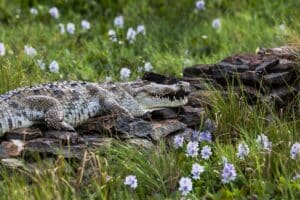
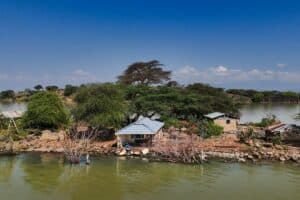
On the roof of what was once a tourist resort—now almost entirely submerged—a crocodile basks in the sun… As the waters of Lake Baringo in Kenya rise and flood the land, crocodiles and hippos are moving dangerously close to the surrounding homes where thousands of families still live.
Like other lakes in the Rift Valley region, the waters of Lake Baringo—located about 200 km northwest of Nairobi—have reached levels not seen in half a century, a phenomenon scientists attribute to extreme rainfall linked to climate change.
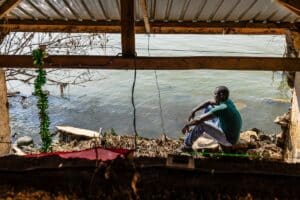
According to the local disaster management authority, tens of thousands of residents living along the shores have already had to be relocated nearby. But some say the lake continues to follow them.
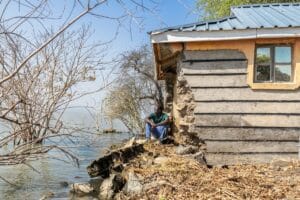
Near a house with water lapping at its doorstep, three more crocodiles are basking.
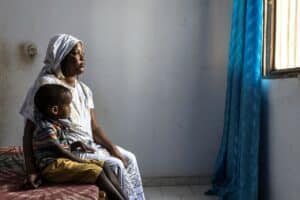
In 2011, the year of the lake’s first significant flood, a hippopotamus attacked and killed Mary Milka Tiren’s husband as he was returning from the hotel where he worked—a hotel that is now also underwater.
Ten years later, a crocodile attacked her nine-year-old son, who was left with several scars after spending three months in the hospital.
The reptile “was trying to rip his arm off,” but the child was rescued, his mother says.
“There has been an increase in crocodile attacks, not because there are more crocodiles, but because the lake is now close to people’s homes,” explains Jackson Komen, director of the Kenya Wildlife Service (KWS) for the Lake Baringo Protected Area. “There are also hippo attacks, because when the lake expanded, the nearby ecosystem” where these mammals used to graze “disappeared.”


– “Ecological Disaster” –
Analysis of satellite imagery shows that Lake Baringo’s surface area has grown by 70% since 2010, increasing from 138 to 234 km² by 2026. At the same time, nearby Lake Bogoria has expanded by 21%, growing from 34 to 41 km².
The shores of the two lakes are now barely 10 km apart. And scientists now fear an “ecological disaster” if they merge and the freshwater of Baringo mixes with the highly saline and alkaline water of Bogoria.
Jackson Komen fears a “complete” and unpredictable change in the ecosystems. “If the two lakes mix, fish, crocodiles, and hippos might not survive,” he adds, predicting “an ecological disaster that we don’t know how to manage.”
“I don’t know if humans will be able to continue living here,” he emphasizes, noting that Baringo provides drinking water and irrigation water and supports a thriving fishing industry.
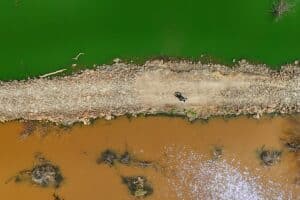
Some experts believe that “overflow is already underway” between the two lakes.
” “Satellite elevation data show that Lake Bogoria’s water level is high enough for it to flow into Lake Baringo,” says Mathew Herrnegger, a researcher at the Institute of Hydrology and Water Management at the University of Natural Resources and Life Sciences in Vienna (Austria), adding that the amount of water likely to flow out and its potential impact remain uncertain.
– “Helpless” –
The rising waters of the two lakes have also severely affected the tourism sector. Approximately “80% of the community-managed nature reserves have disappeared” under the water, notes Jackson Komen, forcing the relocation of giraffes, ostriches, warthogs, and impalas to other areas.
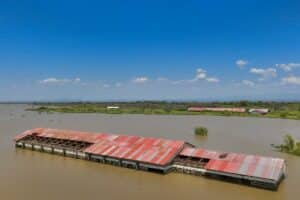
Journalists have seen four hotel complexes now barely emerging from Lake Baringo. Another, empty, lies abandoned on an island.
The flooding of Lake Bogoria has driven away some of the millions of flamingos for which it was famous and engulfed its famous hot-water geysers.
Annual tourism revenue has fallen to one-fifth of its former level and now amounts to only about 200,000 euros, according to Michael Baimet, director of local disaster management services. Online, visitors complain about the low number of flamingos at Lake Bogoria and the impassable roads due to flooding.
Twelve schools on the shores of Baringo and Bogoria are partially or completely submerged, according to official figures.
On Kokwa Island, in the middle of Lake Baringo, water has submerged the fence separating the lake from the girls’ dormitory at the elementary school.
“It’s dangerous for the boarders, with hippos and crocodiles roaming the school grounds at night,” explains a school official who requested anonymity. “We’ve had to hire two security guards.”
The school fears that the heavy rains expected with the El Niño weather phenomenon in October will flood the dormitory.
The island’s residents know that a move is inevitable, but are delaying the decision due to the cost.
Around her plot of land—which used to be one hectare—Faith Mpayei has already moved her fence twice since 2016. But it is submerged once again, and the water continues to advance toward her home.
“We’re helpless,” says this mother of five. “I have to move (…) there’s nothing left to do here.”
Humaniterre with AFP