Libreville, Gabon
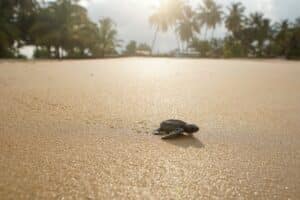
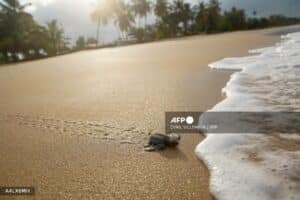
They fit in the palm of a hand. These olive ridley hatchlings have just emerged from their nest on a beach in Gabon. They must cross 10 meters of sand to reach the ocean—a true obstacle course.
At the start, “their chances of survival are minuscule,” with a rate of 1 in 1,000, explains François Boussamba, a Gabonese turtle expert and director of the NGO Aventures sans frontières, to AFP as he scans the white sand for nests on a beach in Pongara National Park, in western Gabon.
Every day during the nesting season, NGOs and eco-guards from the National Agency of National Parks (ANPN) patrol the country’s beaches to protect the eggs and move the most threatened ones to safety.
The beaches of Pongara, a 30-minute boat ride from the capital Libreville, offer an ideal setting for turtle nesting: a wild coastline, an equatorial climate, wide access to the ocean, and gentle slopes perfect for the females.
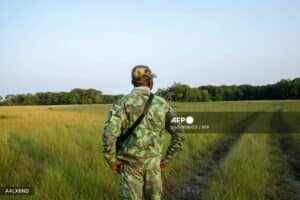
According to the American NGO Wildlife Conservation Society (WCS), this Central African country has the highest nesting density on the continent, with an average of 30,000 to 40,000 nests per year, across all species.
And the country is the world’s leading nesting site for leatherback turtles, a species threatened according to the International Union for Conservation of Nature (IUCN). (Photo by Nao Mukadi / AFP)
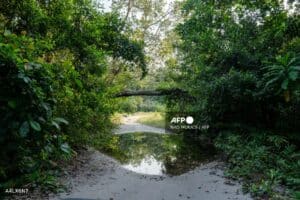
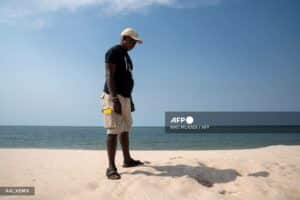
(Photo by Nao Mukadi / AFP)
But there are many dangers, from erosion (the encroaching sea) to numerous predators (domestic animals, crabs, birds, and fish) that prevent the eggs from hatching after the 60-day incubation period, notes François Boussamba.
– Strengthening the hatchlings –
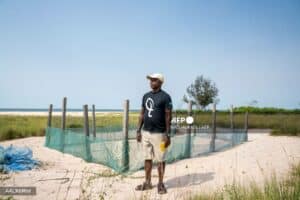

In Libreville, every morning around 7:00 a.m., volunteers from the Tahiti Gabon Turtle Project patrol the beach and check the nests in the hatchery—a fenced-in enclosure nearby where the most vulnerable eggs are taken and kept safe until they hatch.
Once hatched, the baby turtles must be moved to allow them to reach the sea. But putting them directly into the water is out of the question; “they need to build up their strength so they can swim in the ocean,” explains Clémence, a volunteer with the association, while ensuring that nothing obstructs their path to the ocean.
Along its 900 km of coastline, Gabon is home to four species of sea turtles during the nesting season, from October to April: green, olive ridley, hawksbill, and leatherback.
According to the American NGO Wildlife Conservation Society (WCS), this Central African country has the highest nesting density on the continent, with an average of 30,000 to 40,000 nests laid per year, across all turtle species. Gabon is also the world’s leading nesting site for leatherback turtles, the largest of the seven sea turtle species (averaging 1.60 meters in length and 500 kilograms in weight), which is endangered, according to the International Union for Conservation of Nature (IUCN).
By watching over their eggs, Pongara park rangers ensure “the survival of this species,” emphasizes Edouard Moussavou, deputy director of Pongara Park.
Gabon takes pride in its large population of sea turtles. This demonstrates “that our ecosystem is healthy and thriving,” according to François Boussamba.
Faced with multiple threats—including human activities (industrial fishing, plastic pollution, and poaching), as well as coastal erosion and natural predators—Gabon is taking active steps to protect sea turtles.
Since 2013, its conservation efforts have been financially supported by the United States, notably through programs run by the U.S. Fish and Wildlife Service, a U.S. agency responsible for biodiversity.
But since the U.S. administration suspended funding, “turtle monitoring activities have come to a standstill or slowed down significantly,” laments Édouard Moussavou. “There will be fewer staff, less data, and this is truly a challenge for us.”
– Unpaid salaries –
Compounding these difficulties are delays in paying the salaries of ANPN staff, who manage the country’s 13 parks, notes Sosthène Ndong Engonga, secretary general of the National Union of Gabonese Ecoguards (SYNEG). Like other Gabonese civil servants and contract workers, the approximately 580 park rangers regularly find themselves deprived of their salaries.
“Even when there is money, we have to make a fuss to get our salaries,” he laments, adding that he fought with the Treasury in February to secure payment of the arrears.
For these agents, who are essential to the conservation of Gabon’s exceptional biodiversity, the risk is being “forced to give it all up,” he fears, “because we have responsibilities we can no longer meet” without a regular salary.
On a beach in Pongara, Alain Banguiya, 40, conducts night patrols in the hope of seeing a leatherback turtle emerge from the water to lay eggs in the sand. An ecoguard since 2015, he hasn’t been paid for two months now, but for him, giving up is out of the question.
“We have a duty to fight to the end, to stay positive (…) Despite the obstacles, we’re staying the course: conservation,” he says proudly.
Humaniterre with AFP