Actualité

𝐁𝐢𝐨𝐠𝐚𝐬 𝐡𝐞𝐥𝐩𝐬 𝐜𝐮𝐭 𝐛𝐢𝐥𝐥𝐬, 𝐝𝐞𝐟𝐨𝐫𝐞𝐬𝐭𝐚𝐭𝐢𝐨𝐧 𝐢𝐧 𝐞𝐚𝐬𝐭 𝐃𝐑 𝐂𝐨𝐧𝐠𝐨

Goma, DR Congo

Photos: Jospin Mwisha

In her kitchen, Julienne Mukelenge no longer fears toxic fumes or power outages. This resident of Goma, in eastern DRC, has switched to biogas, a cheaper and less polluting energy source produced by a local company.

In this major city in the eastern Democratic Republic of the Congo (DRC), “electricity is expensive, but with biogas, it’s very economical,” says Julienne Mukelenge, wearing her apron, standing in front of a pot engulfed in large blue flames where she is cooking dinner.

A large portion of Goma’s nearly one million residents are too poor to afford electricity and rely heavily on charcoal, known as “makala,” for their daily needs.

The resurgence of the Rwandan-backed armed group M23 in late 2021 in eastern DRC caused an influx of displaced people to the outskirts of Goma. Several hundred thousand of them crowded into makeshift camps on the city’s outskirts, accelerating deforestation in the neighboring Virunga National Park.

After the M23 seized the city in January 2025, the armed group banned logging in the park in Goma, an activity it claims helps finance militias allied with Kinshasa, driving up the price of bags of charcoal

“I used to buy a bag of charcoal to last a month,” but with “the rising price of a bag, gas is cheaper here,” says Romaine Kanyere, a mother of two.

A 6-kg bottle of biogas, purchased for $8, covers the needs of a household of 3 to 5 people for nearly two weeks, compared to $30 per month with charcoal.
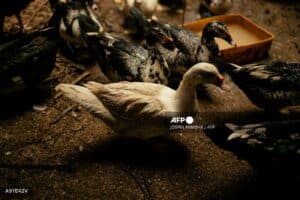
 

Ducks are seen in the duck enclosure of Umoja, a social enterprise that turns environmental challenges into socio-economic opportunities through biogas using animal waste to produce clean energy, in Goma on April 20, 2026. Most of the city’s nearly one million people cannot afford to use electricity and mostly depend on charcoal, called makala, for cooking and heating.
Some people are switching to biogas, a renewable energy source that is cheaper and locally produced.
Biogas is produced by the decomposition of organic matter.
It has been made in Goma since 2016 by Umoja, a local company whose stated aim is to offer an alternative to firewood, which destroys forests. (Photo by Jospin Mwisha / AFP)
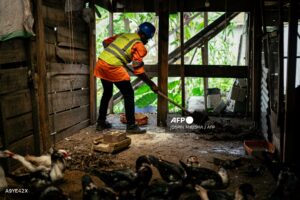
Victoire Materanya, co-founder of Umoja, collects wate from a duck enclosure to transport it to a digester in Goma on April 20, 2026. Most of the city’s nearly one million people cannot afford to use electricity and mostly depend on charcoal, called makala, for cooking and heating.

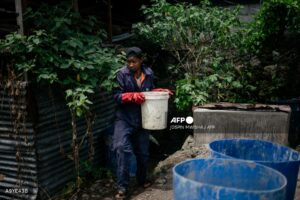
A worker carries a bucket with waste from a duck enclosure to put in the digester in order to produce clean energy in Goma on April 20, 2026. Most of the city’s nearly one million people cannot afford to use electricity and mostly depend on charcoal, called makala, for cooking and heating.

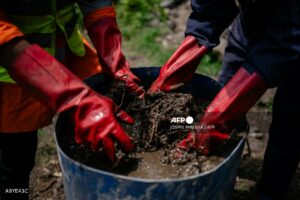
Workers mix waste from a duck enclosure to put in the digester in order to produce clean energy in Goma on April 20, 2026. Most of the city’s nearly one million people cannot afford to use electricity and mostly depend on charcoal, called makala, for cooking and heating.


– Eco-friendly fertilizer –

Biogas, produced from the decomposition of organic matter, has been manufactured in Goma since 2016 by a local company, Umoja, which aims to offer an alternative to firewood, a major threat to forests.

Yves Rubarura, an Umoja employee wearing overalls and protective goggles, collects “thirty cartloads” of manure each week from the company’s chicken coops and those of local partners to fill the “biogas digesters”—concrete pits where the waste is converted into methane before being bottled.

According to him, about fifty of these biogas digesters—which are easy to build and operate—have been constructed in the region by the company, which claims to distribute 720 kg of biogas to its customers each month.

This small-scale production remains limited for now. In Goma, residents lack the space and resources to build their own biogas digesters, according to Victor Materanya, director of the company Umoja. Storage is also an issue, given the lack of suitable tools to pressurize the bottles.

He nevertheless hopes to expand this technology to rural areas, where farmers who supply the compost can then recover the fertilizer produced at the end of the anaerobic digestion process.

Serge Bashonga, an environmentalist in Goma, believes that producing this fertilizer can reduce the use of chemical fertilizers and the environmental damage they cause.

According to him, biogas also helps reduce the “toxic fumes from waste incineration” that poison the air in the capital of North Kivu and the daily lives of its residents.

Humaniterre with AFP

 

Download

the online magazine

Similar items

Pas de pauvreté

Éliminer la pauvreté sous toutes ses formes et partout dans le monde.

No poverty

End poverty in all its forms and everywhere.

Faim«zero»

Éliminer la faim, assurer la sécurité alimentaire, améliorer la nutrition et promouvoir l’agriculture durable.

Zero hunger

Éliminer la faim, assurer la sécurité alimentaire, améliorer la nutrition et promouvoir l’agriculture durable.

Bonne santé et bien-être

Assurer une vie saine et promouvoir le bien-être pour tous à tout âge.

Good health and well-being

Ensure healthy lives and promote well-being for all at all ages

Education de qualité

Assurer une éducation de qualité exclusive et équitable et promouvoir les possibilités d’apprentissage tout au long de la vie pour tous.

Quality education

Ensure exclusive and equitable  quality education and promote lifelong learnig opportunities for all.

égalité entre les sexes

Assurer l’égalité des sexes et l’autonomisation de toutes les femmes et les filles.

Gender equality

Achieve gender equality and empower all women and girls.

Eau propre et assainissement

Assurer la disponibilité et la gestion durable de l’eau et de l’assainissement pour tous.

Clean water and sanitation

Ensure availability and sustainable management of water and sanitation for all.

Energie propre et D’un coût abordable

Assurer l’accès à une énergie abordable, fiable, durable et moderne pour tous.

Affordable and clean energy

Ensure access to affordable, reliable, sustainable and modern energy for all.

Travail décent et croissance économique

Promouvoir une croissance économique soutenue, inclusive et durable, le plein emploi productif et un travail décent pour tous.

Decent work and economic growth

Promote sustained, inclusive and sustainable economic growth, full and productive employment and decent work for all.

Industrie, innovation et infrastructure

Construire des infrastructures résilientes, promouvoir une industrialisation inclusive et durable et encourager l’innovation.

Industry, innovation and infrastructure

Build resilient infrastructure, promote inclusive and sustainable industrialization and foster innovation.

Inégalités réduites

Réduire les inégalités entre les pays et au sein des pays.

Reduced inequalities

Reduce inequalities among and within countries.

Ville et communautés durables

Rendre les villes et les établissements humains inclusifs, sûrs, résiliants et durables.

Sustainable cities and communities

Make cities and human settlements inclusive, safe, resilient and sustainable.

Consommation et production responsable

Assurer des modes de consommation et de production durables.

Responsible consumption and production

Ensure sustainable consumption and production patterns.

Mesure relatives à la lutte contre les changements climatiques

Prendre des mesures urgentes pour lutter contre le changement climatique et ses impacts.

Climate action

Take urgent action to combat climate change and its impacts.

Vie aquatique

Conserver et utiliser durablement les océans, les mers et les ressources marines pour le développement durable.

Life below water

Conserve ans sustainably use the oceans, seas and marine resources for sustainable development.

Vie Terrestre

Protéger, restaurer et promouvoir l’utilisation durable des écosystèmes terrestres, gérer durablement les forêts, lutter contre la désertification, stopper et inverser la dégradation des sols et mettre un terme à la perte de biodiversité.

Life on land

Protect, restore and promote sustainable use of terrestrial ecosystems, sustainably manage forests, combat desertification and halt and reverse land degradation and halt biodiversity loss.

Paix, justice et institutions efficaces

Promouvoir des sociétés pacifiques et inclusives pour le développement durable, assurer l’accès à la justice pour tous et mettre en place des institutions efficaces, responsables et inclusives à tous les niveaux.

Peace, justice, and strong institutions

Promote peaceful and inclusive societies for sustainable development, provide access to justice for all and build effective, accountable and inclusive institutions at all levels.

Partenariats pour la réalisation des Objectifs

Renforcer les moyens de mise en œuvre et revitaliser le partenariat mondial pour le développement durable.

Partnerships for the goals

Strenghen the means of implementation and revitalize the global partnership for sustainable development.