Duekoué, Ivory Coast
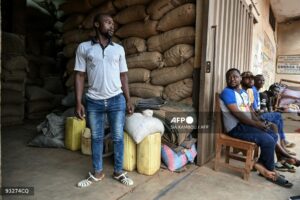
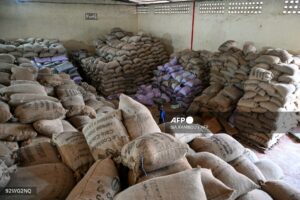
A motorcycle loaded with cocoa rattles into the courtyard of one of the cooperatives in Duekoué, in western Ivory Coast. But its driver will not be able to unload a single bag: 660 tons are already piled up in the warehouse, waiting for weeks to be exported.
The cocoa industry, which accounts for 14% of the country’s gross domestic product (GDP) – the world’s leading exporter – is facing major blockages: exports have virtually come to a standstill and, as in Duekoué, bags are piling up across the country.
On his computer, Siriri Millogo, director of the Duekoué agricultural producers’ cooperative, scrolls through the 13 export requests, known as “bills of lading,” sent to the Coffee and Cocoa Council (CCC), the industry’s regulatory body.
The oldest of these requests dates back to January 4 and remains unanswered. Usually, “validating a bill of lading only takes a few minutes,” says Siriri Millogo, perplexed, as he makes repeated calls to the CCC and exporters without being able to pinpoint the problem.
In Côte d’Ivoire, the purchase price paid to farmers is set by the state twice a year and may not reflect market fluctuations.
In October, a few weeks before his re-election, Ivorian President Alassane Ouattara personally announced a record price of 2,800 CFA francs per kilo (€4.26), a decision welcomed by farmers
However, after reaching nearly $12,000 per ton in 2024, cocoa prices have fallen sharply on the world market since the summer and are struggling to reach $5,000.
“There is no blockage,” according to CCC director Yves Brahima Koné, who sought to ‘reassure’ farmers on Wednesday in front of the press. “All production (…) will be purchased,” he promised.
But “things are heating up in the bush,” warns Siriri Millogo.
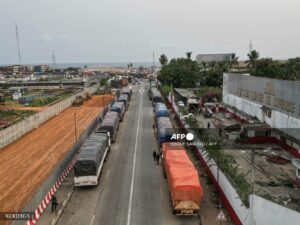
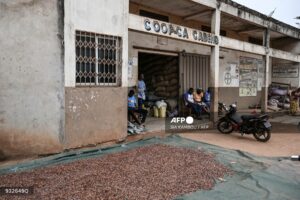
(Photo by Sia KAMBOU / AFP)
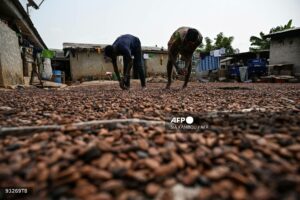
(Photo by Sia KAMBOU / AFP)
– “Taking advantage of farmers” –
Cooperatives operate like consignment stores. Without a bill of lading, there is no export, no payment to the cooperative, and therefore no money paid to producers and their families. Cocoa indirectly supports one-fifth of the Ivorian population.
And cooperatives do not have the cash flow to advance the money.
“Just yesterday, a producer came in. He has a product (harvested cocoa, editor’s note) worth 9 million (CFA francs), but he doesn’t even have 100 francs to pay for his wife’s funeral,” says Marty Somda of the Cabend cooperative, which has had six bills of lading pending since December 20.
In the absence of cash, farmers hold on tightly to their “receipts,” loose sheets of paper that are supposed to certify a buyer’s debt. Many people in Duekoué and the surrounding area are owed several million CFA francs by the cooperatives.
For those who have not received any money since mid-October, selling at bargain prices is becoming a necessity.
“People come to see you and talk about 2,000 francs” per kilo, laments Mathieu Meido, a farmer in Zéo, a nearby sub-prefecture.
“My wife is sick. I was given a prescription. But how can I pay for it? Yesterday, I sold at 2,000 francs because I was in need,” confirms Laurent Koné, a farmer near Duekoué.
In Bettykro, 20 kilometers from Duekoué along a rough red dirt road, ten tons of cocoa, worth more than 28 million CFA francs (nearly 43,000 euros), disappeared with their buyer, who vanished without paying.
“Everyone wants to take advantage of the farmers to get rich and drive prices down,” laments Laurent Koné.
– A familiar slump in sales –
And in this climate of volatile prices, exporters, both domestic and international, are delaying their purchases.
Because “if prices continue to fall, on April 1 (the date of the small harvest) the government will be forced to set a lower price,” says Ousmane Attai Ouedraogo, an independent consultant specializing in the cocoa industry.
Some buyers are also facing other obstacles.
“On Friday, I went to Cargill in Abidjan (a major exporter, editor’s note), they want to buy, but they don’t have any quotas because the CCC won’t issue them any,” says Marty Somda of the Cabend cooperative.
Moussa Koné, from the Synap-ci planters’ union, offers an explanation.
In his view, if the CCC gives its approval and exporters buy at a price of 2,800 CFA francs, they will have a “shortfall of around 1,000 francs” compared to the current market price. However, “the law requires the council to reimburse the shortfall” to exporters, he points out.
A guarantee fund is specifically designed to compensate exporters for losses in this type of situation.
“Why isn’t it being activated?” asks the union leader, echoing the sentiments of many of the farmers he has spoken to. When contacted on this point, the CCC declined to respond.
“It’s a war between the CCC and the exporters,” sums up Ousmane Attai Ouedraogo.
Meanwhile, “those who produce cocoa are not protected,” laments Moussa Koné. This is a paradox in a system where the price guaranteed by the state is supposed to allow producers to live without worrying about market fluctuations.
However, Marty Somda points out that this situation has been seen before. In 2017, for example, during a similar slump in sales, the price of cocoa fell “from 1,100 to 700 francs.”
Humaniterre with AFP