Likasi, DR Congo
By Didier Makal and Latoya Abulu with Glody Murhabazi
Valery Kyembo was leading an inspection of the protected forest reserve managed by his community, in the heart of the Democratic Republic of Congo’s (DRC) mining belt, when two armed soldiers blocked his team’s path.
Behind the soldiers, a barrier blocked access to a developing mining site. One of the soldiers waved his weapon, sending a clear warning: turn back.
As American and other foreign companies compete with China for the DRC’s strategic minerals, communities like Lukutwe, in the province of Haut-Katanga (southeast), fear tighter restrictions and incursions into the reserves as they seek to protect their land.
Supervised by local communities, forest reserves enable sustainable environmental management projects, reforestation, and controlled charcoal production. Specific areas are dedicated to conservation, while others are dedicated to rural development.
The Lukutwe community forest reserve, where Mr. Kyembo lives, has obtained official land titles that are supposed to prevent illegal mining, which is becoming increasingly attractive
But community leaders fear that despite this protected status, they will be driven from their ancestral lands.
Haut-Katanga is rich in minerals, but none is more in demand than cobalt, which is essential for electric batteries and defense technologies. The DRC produces around 70% of the world’s cobalt.
In Lukutwe, 70 km from Lubumbashi, the provincial capital, community leaders explain that they created a forest concession to legalize customary land titles after seeing SEK, a subsidiary of the Australian group Tiger Resources, displace other villages a decade ago.
“We wanted to have our own land” with official titles, says Mr. Kyembo – a sentiment echoed by residents of neighboring villages.
And demand for minerals from Katanga is intensifying.
US President Donald Trump has made “mineral diplomacy” a key part of his strategy for resolving the conflict in eastern DRC, seeking access for American companies in exchange.
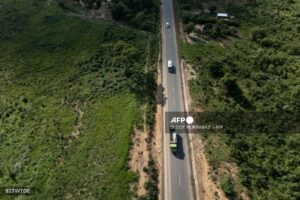
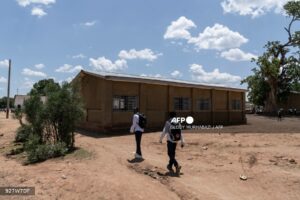
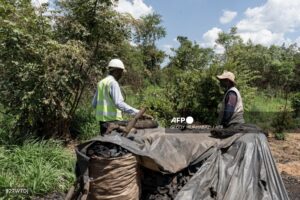
– Self-management –
For villages such as Lukutwe, which had ancestral land rights but no official documents, concessions are a means of securing property titles and protecting ecosystems.
Since 2016, Local Community Forest Concessions (CFCLs) have been an integral part of the DRC’s strategy to allow communities to manage their forests sustainably.
“CFCLs effectively provide a guarantee against land pressure (…), relocation and expropriation by mining operators,” says Héritier Khoji, professor of agronomy at the University of Lubumbashi and specialist in Miombo forests, the world’s largest dry tropical forest ecosystem.
Haut-Katanga now has 20 reserves covering 239,000 hectares. Twelve future reserves are in the process of being approved.
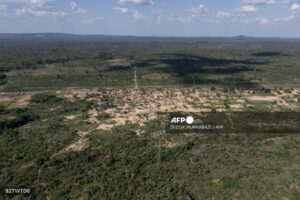
But as in other parts of Africa, the Miombo forests covering the south of the DRC are being eroded by agriculture, deforestation, and increasing mining activity.
Between 2001 and 2024, the neighboring provinces of Lualaba and Haut-Katanga lost 1.38 million hectares of forest cover, mainly along the copper-cobalt belt, according to the NGO Global Forest Watch.
The national mining registry shows that the copper-cobalt belt has one of the highest concentrations of exploration and mining permits in the country.
Environmental and human rights advocates are concerned about threats to waterways, agriculture, and health.
A waste leak from a facility operated by Congo Dongfang Mining (CDM), a subsidiary of the Chinese group Huayou Cobalt, flooded the suburbs of Lubumbashi in November, prompting the Congolese government to suspend the company’s activities.
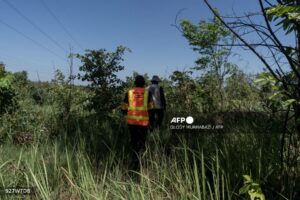
– Pollution risks –
Many reserves in Haut-Katanga are surrounded by or overlap with mining company land.
The future Kambala Forest Reserve, which is awaiting final approval, overlaps with the exploration permit held by MMG Kinsevere SARL, a subsidiary of Australia-based MMG Limited, whose main shareholder is the Chinese company China Minmetals.
Mr. Khoji, the agronomy professor, points out that community forest concessions are not perfect.
Some communities exploit resources in ways that are destructive to the environment. Mining companies can also exploit a concession after obtaining the community’s consent.
But local communities complain that mining companies obtain permits on protected land even without their consent or profit-sharing agreements.
“Although obtaining CFCLs provides a guarantee against land pressures, the difficult enforcement of laws, decrees, ordinances, and other regulations hinders this guarantee,” explains Mr. Khoji.
Politics also plays a role, with poor communities lacking influence in this sector, he adds.
In villages such as Lukutwe, forest concessions often do not generate immediate returns, and the lack of funds discourages some residents, according to Véronique Sebene, representative of a committee managing collective land ownership.
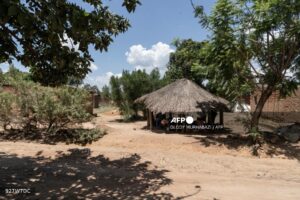
Even though each reserve has a brigade of volunteers monitoring its access points and borders, they face incursions by loggers from Lubumbashi who come to produce charcoal for the regional capital.
“When we patrol the forest concession, these people sometimes surprise us by surrounding us and attacking us. This makes it difficult for us to secure the concession,” laments Kibole Kahutu, vice president of CFCL Katanga.
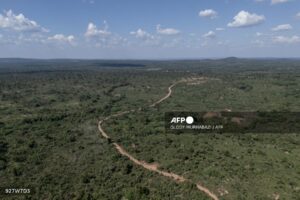
While the forest concessions granted by the government offer some protection, a road built through the CFCL Katanga to reach a mining site is a reminder that one day, a mining company could try to take over these lands.
“Our support in this case is the CFCL documents obtained from the state,” according to Mr. Kahutu.
The DRC’s ministers of the environment and mines, as well as the mining companies SEK and MMG, did not respond to requests for comment.
This article is part of a joint reporting project by Mongabay, an online media outlet specializing in the environment, and Agence France-Presse (AFP).
Humaniterre and AFP.