Naivasha, Kenya
Par Julia Capelle
Photo: Tony Karumba
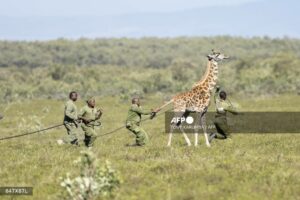
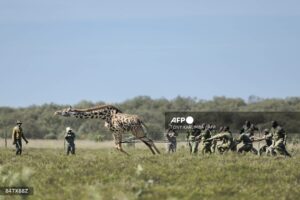
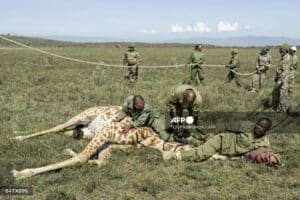
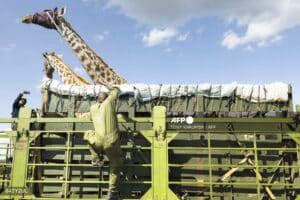
Pulled by long ropes held by around twenty rangers, the blindfolded giraffe enters a trailer with raised sides, which will take it out of a natural area in the Rift Valley that has become hostile, a complex operation that is becoming increasingly common in Kenya.
According to environmentalists, these animal relocations, organized by the national nature conservation agency (KWS), are a last resort in the East African country when human activities or climate change prevent wildlife from surviving or coexisting peacefully with humans.
In recent weeks, hundreds of giraffes, zebras, and antelopes have been moved from Kedong Ranch, a protected private estate on the shores of the famous Lake Naivasha, to other Kenyan reserves.
Long preserved in its wild state, the Kedong Ranch territory has been sold and divided into plots for real estate projects, preventing animals from grazing or using this ancestral passageway between Hell’s Gate and Mount Longonot National Parks.
“A fence is being installed, work is underway,” explains Patrick Wambugu, who organized the operation for the KWS. The giraffes were “isolated and stressed.
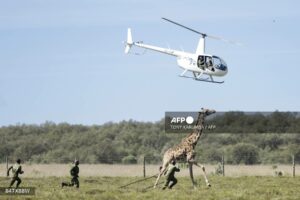
During a visit on Sunday, Mr. Wambugu’s team moved five giraffes in a complex operation involving dozens of people, several vehicles, and even a helicopter, from which the animals scattered across a vast area were spotted and tranquilizer darts were fired.
– Dangerous anesthesia –
According to Dominic Mijele, a KWS veterinarian present at the scene, giraffes are the “most difficult” animals to move. They are fragile and can succumb to a fall, but they can also kick violently at those who approach them.
The imposing mammal must be physically immobilized before it can be transported, but its anesthesia must be brief because “the distance between (its) heart and (its) brain is significant,” he says.
To allow the brain to receive oxygen, the heart must function at full capacity, even though the drugs used slow down the heart rate, the veterinarian explains.
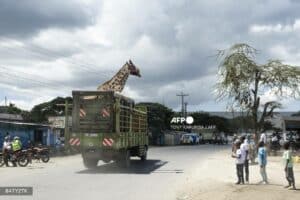
Once blindfolded and awake, the giraffe is guided by ropes into a trailer, which is then hoisted onto the back of a truck, where it will travel alongside another giraffe for around 30 kilometers to its new home, the Oserengoni private reserve.
Once there, the veterinarian will observe them for a week. “Within two days, they should have established their territory,” he estimates, hoping that “in the coming years, their numbers will increase.”
Similar operations are carried out almost every month in Kenya, explains Mr. Mijele, mainly due to environmental degradation. But also because conflicts between humans and wildlife are on the rise.
In a country where the population was estimated at 56.4 million in 2024 by the World Bank, compared to 30 million in 2000, land privatization is accelerating and going hand in hand with intense land speculation.
– Dilemma –
Rural Kenyans often settle in areas that serve as wildlife refuges, notes Evan Mkala, program manager for the International Fund for Animal Welfare (IFAW).
The area around Lake Naivasha, a major tourist destination in the country but also a zone of growing economic activity, is thus “invaded” by humans, he observes.
Faced with rising water levels, a phenomenon that has been going on for several years and has worsened this month due to heavy rains, thousands of people have had to be displaced… along with fourteen giraffes, more than 100 zebras, and many other animals.
But these relocations are “technical and very expensive,” notes Mr. Mkala. They are only triggered when a “critical point” is reached, he continues. However, this is happening more and more frequently in Kenya.
In a country with hundreds of nature parks and private reserves, which generate significant tourism revenue, the challenge is to “reconcile” population growth, economic development, and wildlife conservation, says Philip Muruthi, vice president of the African Wildlife Foundation.
“Do we have to make compromises? Or should we simply identify the areas that need to be protected and those that we risk losing” for wildlife habitat, he asks in an interview.
This is a dilemma faced by many African countries as the continent experiences rapid population growth.
But “Africa does not have to choose between wildlife conservation, nature protection and development,” says Muruthi, who believes that human and animal welfare are “inseparable.”
Humaniterre with AFP