Khartoum, Sudan
By Abdelmoneim ABU IDRIS ALI
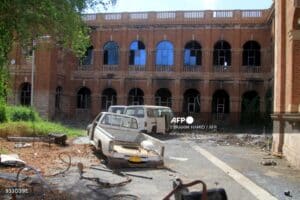
A lush jungle engulfs the courtyard of the Ministry of Finance, littered with burned-out cars, broken glass, and smashed furniture. Vines thrive on the red brick facades inherited from the British colonists who founded Sudan’s capital.
“The site has not been cleared of mines,” warns one of the guards at the building, located in Khartoum in an area classified as red by the United Nations Mine Action Service (UNMAS).
As clashes continue in the neighboring region of Kordofan, Prime Minister Kamel Idris recently announced the return of the pro-army government to the capital after nearly three years of exile in Port Sudan, more than 700 km to the northeast.
Since then, he has been making frequent visits to construction sites and promising a quick return to normalcy.
Thus, although the Central Bank headquarters is little more than a blackened shell with blown-out windows, its management announced this week, without further details, that it would resume operations in Khartoum State, according to the official Suna news agency.
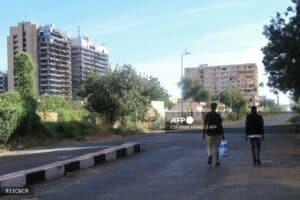
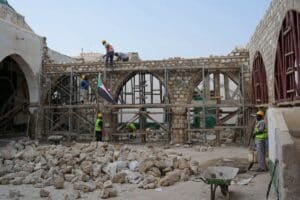
The streets of the capital have been cleared and a few cranes stand here and there in the city ravaged by fighting between the paramilitary Rapid Support Forces (RSF) and the army, which finally regained control last March.
Former allies, the two sides are engaged in a bitter power struggle, and the war has claimed tens of thousands of lives since 2023.
In the government district, the general secretariat and the cabinet presidency have been renovated, but many buildings, riddled with bullets, remain abandoned.
– Empty neighborhood –
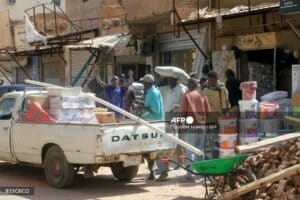
On the broken sidewalk of a ruined intersection, a vendor has set up stools in the shade of a large tree and offers passersby tea or coffee. Halim Ishaq, who has returned from the south where she had taken refuge, has been back in her place “for two weeks.”
“Business is not good, the neighborhood remains empty,” laments the 52-year-old mother, who barely manages to earn 4,000 to 5,000 Sudanese pounds a day (less than two euros), three times less than before the war.
Like her, more than a third of Khartoum’s nine million inhabitants fled when the FSR took the city in the spring of 2023. More than a million have returned since the army’s return.
The population is mainly male: the men have returned to work, leaving their families behind.
“Sales are low, people have no money, and the big companies haven’t come back yet,” laments Abdellah Ahmed, a glazier.
The renovated international airport has remained closed since an FSR drone strike in September shortly before its official inauguration, a sign of the fragility of the situation.
The “Grand Hotel,” which prides itself on having once hosted Queen Elizabeth II of England, hopes to welcome its first guests in mid-February, according to its manager.
The grand lobby and its crystal chandeliers were spared, unlike the rear of the neoclassical building, which was renovated in the late 2000s when oil money was flowing freely.
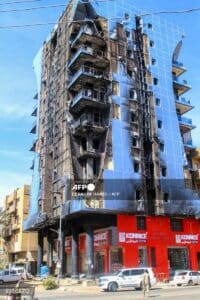
On the horizon, the Greater Nile Petroleum Company tower, one of the symbols of the time when Khartoum dreamed of becoming the Dubai of Africa, has been reduced to a charred skeleton. During the war, the country lost half of its oil revenues, which had already been cut by three-quarters after South Sudan seceded in 2011.
“Many traders are not coming back because the big companies that supplied them are asking them for money” to reimburse them for destroyed stock, explains Osman Nadir, 40, an electrical appliance salesman who is himself facing legal proceedings.
The general consensus is that the priority remains to restore water and electricity supplies and to ensure full security.
– Dark streets –
When night falls, “the streets are dark and deserted, and we don’t feel safe,” says Taghrid Awad al-Rim Saïd, a 26-year-old medical intern. “I used to be able to go out with my friends, and I want to get my social life back, like before.”
“Like before, and even better than before!” hopes the former director of the National Theater, Abdel Rafea Hassan Bakhit, a retiree involved in repairing the building, where volunteers are restoring the stage with its dusty curtains, which has seen the likes of Oum Khaltoum and Louis Armstrong perform.
In recent weeks, there has been a succession of official visits to the city, each time with promises of aid.
The UN estimates that it will cost around $350 million to rebuild the infrastructure.
In the red and yellow stands of Al-Merreikh Stadium, nicknamed “the red castle,” workers are busy pulling up invasive shrubs.
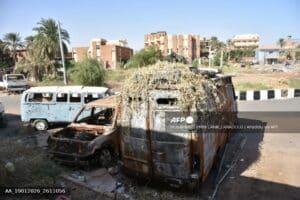
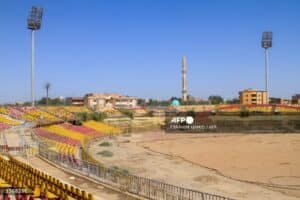
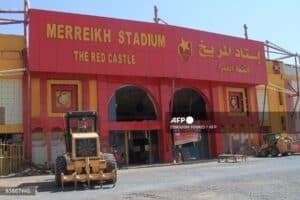
The soccer field has been leveled, and two construction machines lie idle in the courtyard.
In the lobby, a few dusty photographs have escaped looting.
The last game was played a week before the war. Since then, the club, one of the oldest in Africa, has been playing in Rwanda’s first division.
Humaniterre