Mborine, Senegal
Monday, December 8, 2025
By Becca Milfed
Photo Nicolas Remene
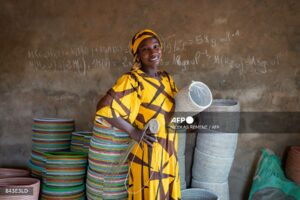
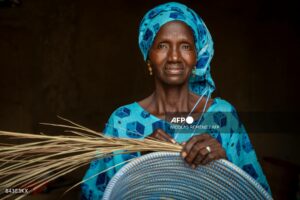
In the shade of a large mango tree in a sandy courtyard in her village in northwestern Senegal, Khady Sène rhythmically weaves reeds, the first steps in making a colorful basket.
Although this craft, typical of this West African country, is sold all over the world, sometimes at high prices, the women who produce these baskets feel that they do not reap the benefits commensurate with their success.
Like many afternoons during the week, Khady Sène and a dozen other women gather to weave, a technique passed down from mother to daughter for generations.
The women of the village of Mborine rarely have the opportunity to leave this remote region of Senegal, but their creations can be found in home decor stores in the United States and France.
For an authentic “Made in Senegal” basket, prices can reach hundreds of euros, of which Senegalese craftswomen receive a tiny share.
“I’ve been doing this work since I was born,” says Khady Sène in her courtyard, where animals can be heard bleating behind the cinder block walls.
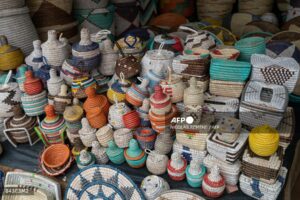
These baskets, which originate from Wolof villages in the northwest of the country, are woven from reeds tied together with colored plastic threads, which used to be palm fibers
Laundry baskets, storage boxes, or presentation trays: women produce a variety of woven items that are sold on the roadsides of Senegal and in craft markets.
“Those who buy them at the market take them from us at a ridiculously low price that doesn’t even cover our costs,” protests this 35-year-old mother.
While a laundry basket sells for around 13,000 CFA francs (US$18) at the market, those exported abroad—through intermediaries—can sell for over US$200.
Khady Sène would like more help from the authorities to defend this craft with its strong national identity and help women “make a living from this work.”
Especially since, if you look closely at the labels of some similar products in Western stores, they are likely to have been made in Vietnam, a major producer of copies.
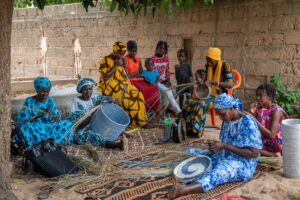
Flip over the price tag on a Senegalese-style basket in a Western box store, however, and there is a high chance it was made in Vietnam, a large exporter of knockoffs. Meanwhile, the price for authentic handmade Senegalese baskets can be astronomical abroad, with little of the markup going to the weavers. While a large laundry-style basket might sell for 13,000 CFA francs ($23) at a market after passing through a middleman, those exported abroad go for well over $150. (Photo by NICOLAS REMENE / AFP)
– Global market –
During a trip to Vietnam in 2017, Fatima Jobe, a Senegalese-Gambian architect, was astonished to discover a wholesaler claiming to be the world’s largest exporter of Senegalese-style basketry… even though it was made in Asia.
Already having connections with basket weavers, she decided to take action to defend them. “There are all these wonderful basket weavers who are ready to work,” says Fatima Jobe.
A few years later, she is now the owner of Imadi, a well-known basket shop in Dakar, which works with 260 women, including Khady Sène, in 15 villages.
Most of the designs are her own creations, often in sober colors and decorated with leather, which she manages to export abroad. Some are traditional, such as the wicker baskets called “layu,” while others are innovations.
Fatima Jobe does not earn her living from Imadi and has another job. But she hopes one day to make this business her livelihood.
She has introduced a higher pay scale, banned child labor, and has been able to finance schools in the villages. She delivers the raw materials directly to the women herself, then transports the baskets, saving them time at the markets.
Those who “pay us according to our efforts” like Fatima Jobe are “rare,” says Khady Sène.
And Senegal lacks the infrastructure and support needed to compete with the big Vietnamese exporters, laments Fatima Jobe.
– “Ridiculously low prices” –
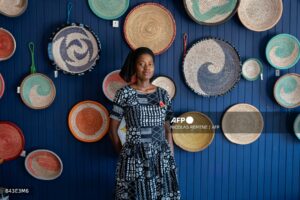
In her shop along a dusty national road about 30 kilometers from Mborine, Fatim Ndoye sells colorful baskets of all sizes to tourists
She buys them from local women at the market on Mondays. “The baskets sell for ridiculously low prices in Senegal,” she says, explaining that she sells 3,000 francs (US$3.50) worth of baskets on weekdays and 10,000 francs (US$10.50) worth on weekends.
Despite the tiny margins, this income is essential in a country where thousands of young people are leaving to escape economic hardship.
Adama Fall, a 49-year-old widow, manages to support her family as a coordinator for Imadi and by weaving large baskets.
In her village of Thiembe, several young men have left to try to reach Europe by pirogue via the perilous Atlantic route. Four of them have not been heard from in five years.
Near her in the courtyard, her youngest daughter plays with a group of children around the baskets they have made: the seams are undone, plastic threads stick out, but they contain the knowledge of the generations that came before them.
Humaniterre avec AFP