Support our media : https://whydonate.com/fr/fundraising/media-humaniterrenet
Conakry, Guinea
Investigation by: Lucy PEYTERMANN
Photo: Patrick Meinhardt
“I know that the boat my son was on sank, but they haven’t shown us his body. So to say that the little one is dead, I don’t know…” says Abdoul Aziz Baldé, sobbing. His son, Idrissa, left Guinea in search of a better future and is now missing off the coast of Morocco.
Like him, thousands of young people who left Guinea illegally have disappeared during their journey to Europe, plunging their families into agonizing anguish and helplessness.
This phenomenon affects several West African countries, but the numbers are multiplied in Guinea, which in recent years has become one of the main African countries of origin for young migrants on their way to the Maghreb and Europe.
Their traces disappear before a planned departure by sea in overloaded boats, a desert crossing at the mercy of smugglers who sometimes abandon them, during a police raid in the Maghreb, during imprisonment in Libya or in a detention center, or in a European city where they decide to disappear voluntarily, consumed by shame at having failed in their dream.
Often left to fend for themselves, their families are reduced to searching for their children by scouring Facebook for clues about where they have been or watching macabre WhatsApp loops that show photos of young corpses in morgues or washed up on beaches after shipwrecks.
But for the past year, a local NGO, the Guinean Organization for the Fight Against Irregular Migration (OGLMI), has been bringing a glimmer of hope and humanity. It has begun pioneering work to identify the families of the missing and help them in their search.
“Out of every 100 migrants who leave, at least 10 will not return,” explains Elhadj Mohamed Diallo, 38, executive director of OGLMI.
While the number of missing Guineans is in the “thousands,” the subject remains taboo in the country and among international institutions, he laments.
On this autumn morning, he crisscrosses the capital, Conakry, on his red motorcycle, with his colleague Tidiane as a passenger, then bumps along the unpaved streets of a suburb.
– “Let me go to their house” –
This is the first time he has come to meet the family of Idrissa, who has been missing for over a year.
“He’s my first son… A very intelligent child” who would be 29 today, says his father, Abdoul Aziz Baldé, a 62-year-old driver who has been through a lot.
The family lives in a house shared with roommates, where the poverty is striking.
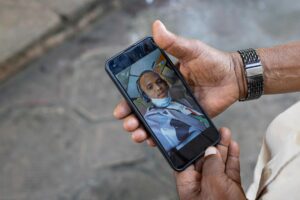
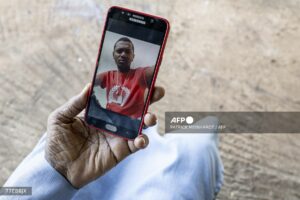
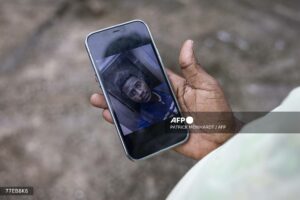
With every family we meet, it’s the same ritual. In painful contemplation, Idrissa’s parents scroll through their WhatsApp threads on their phones to find the last visual trace of their child. In one of the last photos sent, a selfie, the young man’s face appears smiling.
“If we manage to find his body, I want to do everything I can to bring him home. Because he left to save us and save his little sister. But God didn’t want that…” his father whispers, breaking down in tears.
Idrissa said he couldn’t bear to see his father exhausting himself at work at over 60 years old. Despite his brilliant studies, like many other young Guineans, he saw no opportunities in the country.
His father can still hear him saying: “You’re tired, you can’t drive anymore. Let me go to them (in Europe) to find a way to make a living.”
Starting in 2023, Idrissa tried three times to go to Europe via Morocco. Each time, his father tried to stop him. Then he left a fourth time in 2024, taking with him in his backpack “all his diplomas, from his high school diploma to his master’s degrees,” his father later discovered.
On August 19, 2024, his father received a call. “Are you Baldé? Do you have a son in Morocco? My condolences,“ said the man on the other end of the line. ”They boarded small boats… They drowned.”
“The news devastated me,” said Mr. Baldé. “The whole family cried.”
Idrissa disappeared in a boat that capsized on August 17.
“The blow knocked me down,” says Mr. Baldé. “The whole family cried.”
Idrissa disappeared in a boat that capsized on August 17, 2024, a young girl who was on board with him confirmed. “When they hit the wave, she lost consciousness. So she doesn’t know where Idrissa went. Is he dead? Is he not dead?” his father asks, exhausted.
– “Abandoned” –
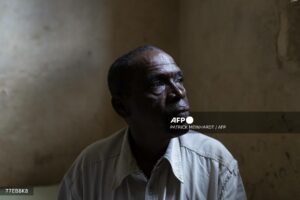
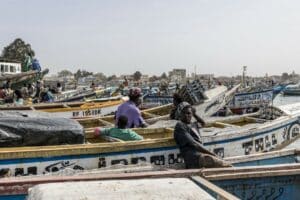
The problem, which affects families across west Africa, is particularly pronounced in Guinea, which has become one of the main departure points for those heading to the Maghreb and Europe.
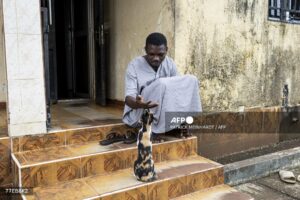
One day they are in communication, the next seemingly gone forever. (Photo by PATRICK MEINHARDT / AFP)
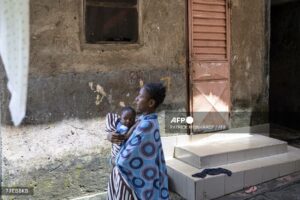
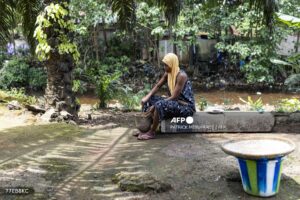
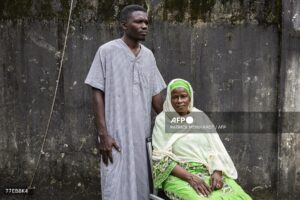
According to the International Organization for Migration (IOM), at least 33,220 people died or disappeared in the Mediterranean and 17,768 on the African continent during their migratory journeys to Europe between 2014 and 2025.
These figures are considered to be greatly underestimated, according to the Spanish NGO Caminando Fronteras, which in 2024 alone recorded 10,457 people dead or missing at sea “at the western Euro-African border.”
Among them are “many people from Guinea,” Helena Maleno, founder of the NGO, confirmed to AFP.
Among the relatives of the missing, “some people have strokes when they hear the news, others suffer from insomnia and amnesia,” said Guinean researcher Mahmoud Kaba, who is conducting a large-scale study on these families in Guinea.
These families are isolated, as Europe restricts visas and increasingly controls its borders, migrants are criminalized, and the tragedy of deaths on migration routes often meets with indifference.
Abdoulaye Diallo, 67, who has been struggling since the disappearance of his eldest son, Abdou Karim, two years ago, told AFP that he feels “abandoned.”
He has been consumed by anxiety since March 2023, when his son, who would now be 25, stopped sending him messages. The last traces of Abdou’s life on Facebook date back to November 2023.
From the age of 18, in 2018, he left several times, first to Morocco, then Tunisia, then a year in Libya, where he was imprisoned. Then, after returning to Conakry, he went back to Algeria and then Morocco, from where he planned to travel to Spain.
” It was in 2023, he left for a dangerous area… ” continues Mr. Diallo, who believes his son passed through the Gourougou forest, east of Tangier (Morocco), which over the years has become a precarious base for thousands of migrants from sub-Saharan Africa seeking to enter the Spanish enclave of Melilla.
Moroccan authorities regularly conduct raids there to remove migrants from the forests.
“There is violence, especially on the part of the police. It is a country where lives are senselessly lost…,” Mr. Diallo whispers, before breaking down in tears.
“There is no shame” in being the parents of young people who have disappeared during migration, he believes. Because “it is a wind that has blown in front of every house in Africa, due to poor governance.”
“I suppose he fell victim to bandits or police violence,” adds Mr. Diallo, his eyes reddened, now contemplating a memorial service. “But until I see real proof” of his death, “it’s hard to believe.”
– Support group –
The problem, which affects families across west Africa, is particularly pronounced in Guinea, which has become one of the main departure points for those heading to the Maghreb and Europe.
One day they are in communication, the next seemingly gone forever. (Photo by PATRICK MEINHARDT / AFP)
The problem, which affects families across west Africa, is particularly pronounced in Guinea, which has become one of the main departure points for those heading to the Maghreb and Europe.
One day they are in communication, the next seemingly gone forever. (Photo by PATRICK MEINHARDT / AFP)
When migrants disappear, or their families suspect they have been arrested, they alert the authorities in Guinea by sending them what little information they have. But often nothing happens, notes Elhadj Mohamed Diallo of the OGLMI, who, to ease their distress and break their isolation, has set up WhatsApp groups in local languages, as well as a support group.
The junta that has been in power in Guinea since 2021 is reluctant to publicly discuss the phenomenon of illegal migration.
“Admitting that we are losing citizens at sea is also admitting political failure and that we are not doing enough for our citizens,” says researcher Mahmoud Kaba.
The director general of the Directorate General for Guineans Abroad, Mamadou Saïtiou Barry, urges caution when using the term “missing,” saying
According to him, many of those who are not dead “have not succeeded and refuse to communicate,” or “are hospitalized” or “under arrest or in detention.”
He points out that the authorities have provided assistance to the families of shipwreck victims of whom they are aware—often the rare cases reported in the media.
“Whether in the country of origin, transit, or destination, there is no recognition of this tragedy and the fact that the number of victims is so high,” says Helena Maleno of Caminando Fronteras. “There are sometimes villages where half of the young people are missing.”
“Families have the right to know the truth and to file a complaint, the missing have the right to be searched for, and the dead have the right to be buried with dignity. But getting states to recognize this is very complicated,” she says.
After receiving a report of a disappearance from families, the NGO OGLMI travels to meet with relatives throughout Guinea and collects as much information and identifying details as possible, which it then passes on to associations or activists in the Maghreb, Europe, Mexico, Argentina, the United States, and elsewhere.
The NGO’s contacts are sometimes sent to visit the anonymous graves in the “migrant sections” of cemeteries in the Maghreb or southern Europe, or to morgues.
Elhadj Mohamed Diallo also highlights a lesser-known reality: many young migrants suffer from mental illness after being tortured in prison in Libya, beaten by police in Morocco, or witnessing the death of a friend or loved one on the road.
He himself has come a long way: he attempted to migrate to Europe several times between 2015 and 2017. Detained in prison in Libya in 2017, he saw people die, was “sold” twice in Libya, and violently assaulted several times.
Many Guinean families are also prey to people who try to take advantage of their distress by selling them proof of life of their missing relatives at high prices.
– “Don’t forget them” –
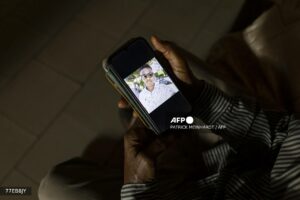
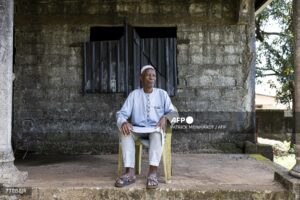
On the day we meet him in Conakry, Idrissa Diallo, 65, is desperately seeking answers about the disappearance of his son Aladji in Libya four years ago. He confides that he spoke that very morning to his marabout, whom he consults regularly: “He assured us that Aladji is alive…”
Mr. Diallo receives us on the porch of his house, which is under construction and frozen in time. His son attempted the “adventure”—a term used in the region to refer to migration—in 2020 to find work and help his parents finance the construction.
Aladji left for Dakar, Senegal, in 2020, then traveled to Mali, Algeria, and Libya, where he worked in a garage before boarding a pirogue in April 2021 to try to reach Europe via Tunisia.
“People told us that they couldn’t cross and that they were ‘scattered’. We haven’t heard from him since,” says his father. As the body has never been found, Mr. Diallo is “not sure” that his son is dead. “Maybe he was arrested and imprisoned in Libya or Italy,” he hopes.
“As long as they don’t have confirmation of death, there is hope,” Elhadj Diallo emphasizes.
Because amid the tragedies, searches sometimes yield results, such as that of Tahibou Diallo, 58, after two years without news of her son Thierno.
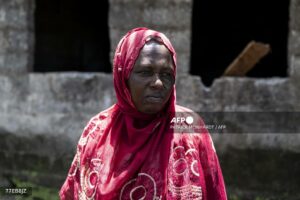
AFP accompanied Elhadj when he came to meet Tahibou for the first time. The mother was clearly distraught because she had helped her son travel to Spain. “He told me he was going to study there…,” she said. Thierno then went to France, where he disappeared.
“My hope is that you will help me find him,” Tahibou said to Elhadj, distraught.
In October, thanks to a network of associations, the OGLMI was able to locate the young man, alive and homeless in Nantes, in western France. He is apparently in very bad shape, but his mother was able to talk to him again and rebuild their fragile bond.
Other families have approached the NGO, which has been searching for over a year, leaving little hope. “These families need support to grieve,” pleads Mr. Diallo. “We must not forget all these missing people.”
Humaniterre with AFP