Actualité

𝐃𝐑 𝐂𝐨𝐧𝐠𝐨’𝐬 𝐚𝐦𝐩𝐮𝐭𝐞𝐞𝐬 𝐛𝐞𝐚𝐫 𝐬𝐜𝐚𝐫𝐬 𝐨𝐟 𝐲𝐞𝐚𝐫𝐬 𝐨𝐟 𝐜𝐨𝐧𝐟𝐥𝐢𝐜𝐭

Goma, DR Congo

They survived the bombs and bullets, but many lost an arm or a leg when M23 fighters seized the city of Goma in the eastern Democratic Republic of Congo nearly a year ago.

Lying on a rug, David Muhire arduously lifted his thigh as a carer in a white uniform placed weights on it to increase the effort and work the muscles.

The 25-year-old’s leg was amputated at the knee — he’s one of the many whose bodies bear the scars of the Rwanda-backed M23’s violent offensive.

Muhire was grazing his cows in the village of Bwiza in Rutshuru territory, North Kivu province, when an explosive device went off.

He lost his right arm and right leg in the blast, which killed another farmer who was with him.

Fighting had flared at the time in a dramatic escalation of a decade-long conflict in the mineral-rich region that had seen the M23 seize swathes of land.

The anti-government M23 is one of a string of armed groups in the eastern DRC that has been plagued by internal and cross-border violence for three decades, partly traced back to the 1994 Rwanda genocide.

Early this year, clashes between M23 fighters and Congolese armed forces raged after the M23 launched a lightning offensive to capture two key provincial capitals.

The fighting reached outlying areas of Muhire’s village — within a few weeks, both cities of Goma and Bukavu had fallen to the M23 after a campaign which left thousands dead and wounded.

Despite the signing in Washington of a US-brokered peace deal between the leaders of Rwanda and the DRC on December 4, clashes have continued in the region.
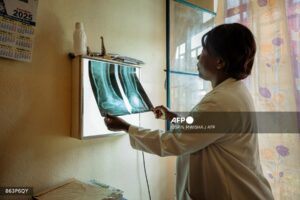
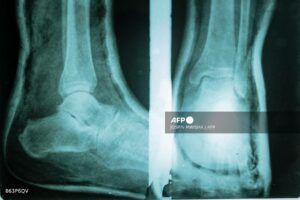
 

A general view of a control x-ray of a disabled patient displayed on the negatoscope after an imaging exam showing a fibula fracture, at the Shirika la Umoja centre in Goma, on November 20, 2025. (Photo by Jospin Mwisha / AFP)
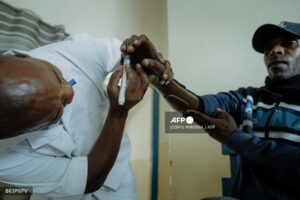
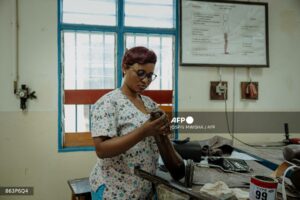
Andre Mbuguja, an ortho-prosthetist technician who is also a person with disabilities and a former beneficiary of the centre’s pose after care, tightens an angle on the modal transfer device (the knee joint of the prosthesis) intended for a patient, in the fitting room of the Shirika la Umoja centre in Goma, on November 19, 2025.
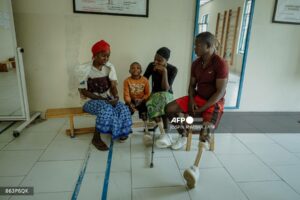
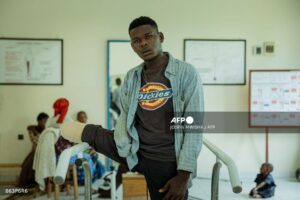
Patrick Ndagije’s mother, from Bishushe in Rutshuru territory and injured by a bullet in 2024, sits beside other patients with disabilities, in the gait rehabilitation room at the Shirika la Umoja centre in Goma, on November 19, 2025. (Photo by Jospin Mwisha / AFP)
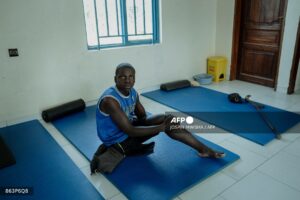
A young patient from Rutshuru territory, who lost a limb in January 2025 and was taken care of by the ICRC before being transferred to the centre, sits on rehabilitation mats after technicians have finished adjusting his prosthesis at the Shirika la Umoja centre in Goma, on November 19, 2025. (Photo by Jospin Mwisha / AFP)
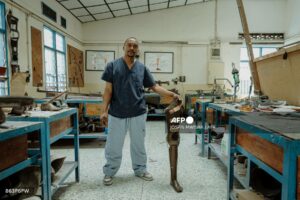
Mathieu Bitegethimana, head of department and ortho-prosthetist technician, poses for a photograph in the prosthesis rectification room of the Shirika la Umoja centre in Goma, on November 19, 2025.  (Photo by Jospin Mwisha / AFP)
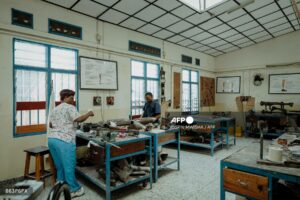
André Mbuguja (C) and Wivivine Mukata (L), two ortho-prosthetist technicians who are also persons with disabilities and former beneficiaries of the centre’s care, work on an orthosis and a prosthesis for a patient in the fitting room of the Shirika la Umoja centre in Goma, on November 19, 2025. . (Photo by Jospin Mwisha / AFP)

Just days after the signing, the M23 group launched a new offensive, targeting the strategic city of Uvira on the border with the DRC’s military ally Burundi.

More than 800 people with wounds from weapons, mines or unexploded ordnance have been treated in centres supported by the International Committee of the Red Cross (ICRC) in the eastern DRC this year.

More than 400 of them were taken to the Shirika la Umoja centre in Goma, which specialises in treating amputees, the ICRC said.

“We will be receiving prosthetics and we hope to resume a normal life soon,” Muhire, who is a patient at the centre, told .
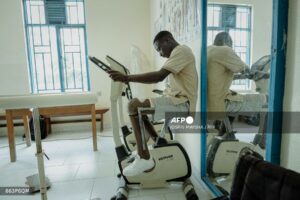


A young patient who lost a limb sits on a pedal sports bike and pedals to strengthen his new prosthesis after it was adjusted to his body, at the Shirika la Umoja centre in Goma, on November 19, 2025.

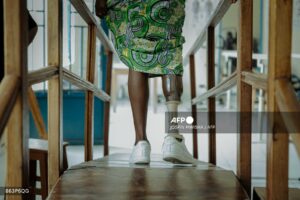
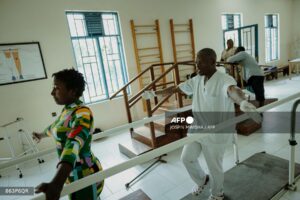
A patient who lost a limb practices on the parallel bars in the rehabilitation room at the Shirkia la Umoja Trauma Center in Goma, on November 20, 2025.
A patient tests her new prosthesis at the Shirika la Umoja centre in Goma, on November 19, 2025.
Patrick Ndagije’s mother, from Bishushe in Rutshuru territory and injured by a bullet in 2024, sits beside other patients with disabilities, in the gait rehabilitation room at the Shirika la Umoja centre in Goma, on November 19, 2025.
Mathieu Bitegethimana, an ortho-prosthetist technician and head of department, takes measurements for a patient’s orthosis during a fitting session at the Shirika la Umoja centre in Goma, on November 19, 2025.
A young patient from Rutshuru territory, who lost a limb in January 2025 and was taken care of by the ICRC before being transferred to the centre, sits on rehabilitation mats after technicians have finished adjusting his prosthesis at the Shirika la Umoja centre in Goma, on November 19, 2025.

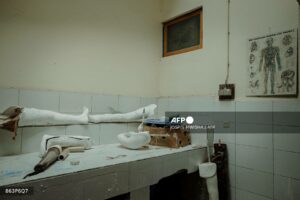
A general view of prostheses still in the design phase in the prosthesis rectification room of the Shirika la Umoja centre in Goma, on November 19, 2025.

– ‘Living with the war’ –

In a next-door room, other victims of the conflict, including children, pedalled bikes or passed around a ball.

Some limped on one foot, while others tried to get used to a new plastic leg.

“An amputation is never easy to accept,” ortho-prosthetist Wivine Mukata said.

The centre was set up around 60 years ago by a Belgian Catholic association and has a workshop for producing prostheses, splints and braces.

Feet, hands, metal bars and pins — entire limbs are reconstructed.

Plastic sheets are softened in an oven before being shaped and cooled. But too often the centre lacks the materials needed, as well as qualified technicians.

Each new flare-up in fighting sees patients pouring into the centre, according to Sylvain Syahana, its administrative official.

“We’ve been living with the war for a long time,” he added.

Some 80 percent of the patients at the centre now undergo amputation due to bullet wounds, compared to half around 20 years ago, he said.

“This clearly shows that the longer the war goes on, the more victims there are,” Syahana said.


Humaniterre avec AFP


Download

the online magazine

Similar items

Pas de pauvreté

Éliminer la pauvreté sous toutes ses formes et partout dans le monde.

No poverty

End poverty in all its forms and everywhere.

Faim«zero»

Éliminer la faim, assurer la sécurité alimentaire, améliorer la nutrition et promouvoir l’agriculture durable.

Zero hunger

Éliminer la faim, assurer la sécurité alimentaire, améliorer la nutrition et promouvoir l’agriculture durable.

Bonne santé et bien-être

Assurer une vie saine et promouvoir le bien-être pour tous à tout âge.

Good health and well-being

Ensure healthy lives and promote well-being for all at all ages

Education de qualité

Assurer une éducation de qualité exclusive et équitable et promouvoir les possibilités d’apprentissage tout au long de la vie pour tous.

Quality education

Ensure exclusive and equitable  quality education and promote lifelong learnig opportunities for all.

égalité entre les sexes

Assurer l’égalité des sexes et l’autonomisation de toutes les femmes et les filles.

Gender equality

Achieve gender equality and empower all women and girls.

Eau propre et assainissement

Assurer la disponibilité et la gestion durable de l’eau et de l’assainissement pour tous.

Clean water and sanitation

Ensure availability and sustainable management of water and sanitation for all.

Energie propre et D’un coût abordable

Assurer l’accès à une énergie abordable, fiable, durable et moderne pour tous.

Affordable and clean energy

Ensure access to affordable, reliable, sustainable and modern energy for all.

Travail décent et croissance économique

Promouvoir une croissance économique soutenue, inclusive et durable, le plein emploi productif et un travail décent pour tous.

Decent work and economic growth

Promote sustained, inclusive and sustainable economic growth, full and productive employment and decent work for all.

Industrie, innovation et infrastructure

Construire des infrastructures résilientes, promouvoir une industrialisation inclusive et durable et encourager l’innovation.

Industry, innovation and infrastructure

Build resilient infrastructure, promote inclusive and sustainable industrialization and foster innovation.

Inégalités réduites

Réduire les inégalités entre les pays et au sein des pays.

Reduced inequalities

Reduce inequalities among and within countries.

Ville et communautés durables

Rendre les villes et les établissements humains inclusifs, sûrs, résiliants et durables.

Sustainable cities and communities

Make cities and human settlements inclusive, safe, resilient and sustainable.

Consommation et production responsable

Assurer des modes de consommation et de production durables.

Responsible consumption and production

Ensure sustainable consumption and production patterns.

Mesure relatives à la lutte contre les changements climatiques

Prendre des mesures urgentes pour lutter contre le changement climatique et ses impacts.

Climate action

Take urgent action to combat climate change and its impacts.

Vie aquatique

Conserver et utiliser durablement les océans, les mers et les ressources marines pour le développement durable.

Life below water

Conserve ans sustainably use the oceans, seas and marine resources for sustainable development.

Vie Terrestre

Protéger, restaurer et promouvoir l’utilisation durable des écosystèmes terrestres, gérer durablement les forêts, lutter contre la désertification, stopper et inverser la dégradation des sols et mettre un terme à la perte de biodiversité.

Life on land

Protect, restore and promote sustainable use of terrestrial ecosystems, sustainably manage forests, combat desertification and halt and reverse land degradation and halt biodiversity loss.

Paix, justice et institutions efficaces

Promouvoir des sociétés pacifiques et inclusives pour le développement durable, assurer l’accès à la justice pour tous et mettre en place des institutions efficaces, responsables et inclusives à tous les niveaux.

Peace, justice, and strong institutions

Promote peaceful and inclusive societies for sustainable development, provide access to justice for all and build effective, accountable and inclusive institutions at all levels.

Partenariats pour la réalisation des Objectifs

Renforcer les moyens de mise en œuvre et revitaliser le partenariat mondial pour le développement durable.

Partnerships for the goals

Strenghen the means of implementation and revitalize the global partnership for sustainable development.