Kédougou, Senegal
By Becca MILFELD
In the poor far southeast of Senegal, where hard labor in artisanal gold mines is one of the main activities, Michel Tama Sadiakhou escaped the dangers of the mine to live a rare destiny: he is part of a pioneering research project on a clan of chimpanzees with a unique lifestyle.
For Michel and four other residents of the region, all but one of whom have no high school diplomas, this project has proven to be an unexpected opportunity to escape poverty or the ordeal of working in the mines and immerse themselves in scientific research.
“It’s really a stroke of luck. I really couldn’t have imagined it,” says Mr. Sadiakhou, referring to his participation in the Fongoli Savanna Chimpanzee Project, founded in 2001 by American primatologist Jill Pruetz.
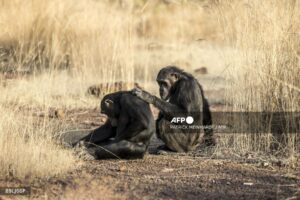
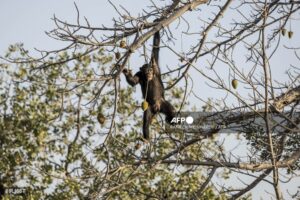
Their unusual lives offer clues as to humans’ own evolutionary past as we migrated to new climates, while their adaptations to the heat feel timely in a world where temperatures are on the rise. (Photo by PATRICK MEINHARDT / AFP)
Pruetz has made several fascinating discoveries while studying a community of about 30 West African chimpanzees, which she has named the Fongoli chimpanzees.
The group lives in the bush rather than the forest, alongside other chimpanzee clans, in the Kédougou region of Senegal, on the border with Mali and Guinea.
The females of Fongoli are the only animals in the world that have been proven to hunt regularly using tools, making spears from tree branches to kill small primates called galagos.
– “Second family” –
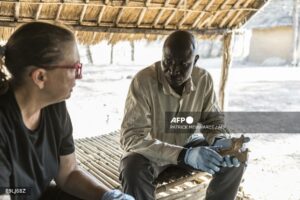
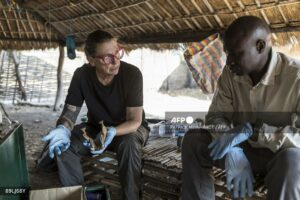
On this sunny morning, Michel Sadiakhou and the other researchers are hard at work, observing and taking notes on these chimpanzees.
Every day, they must choose one adult male to follow from among the ten in the colony.
Not far from them, Mike, a charismatic middle-aged member of the group, strolls through the savanna with a baobab fruit hanging from his mouth by a stem—a snack for later.
The researchers, who belong to the local Bedik and Bassari ethnic groups in the region, note everything from vocalizations to food consumption, social interactions, and support drumming (rhythmic beating on trees).
Mr. Sadiakhou, 37, who has been working on the project since 2009, describes the chimpanzees as a “second family.”
“When I’m with the chimpanzees, it’s like I’m with other people,” he says of his relationship with the primates living in an area spanning 100 square kilometers.
Now a senior researcher and father of four, he had never seen a chimpanzee when he left his job in the “risky” gold mines, known locally as “dioura.”
His colleague Nazaire Bonnag, 31, also decided to give up this activity after witnessing the death of a man who never came back up from the mine where he was working.
Since then, “I said no, I can’t go on like this,” he explains from the researchers’ permanent camp, made up of thatched huts.
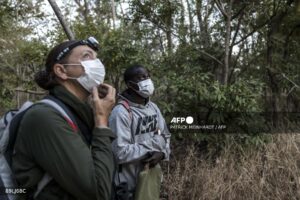
The group of rare chimpanzees they research live in the bush instead of the forest alongside other chimp communities in Senegal’s Kedougou region, on the border with Mali and Guinea.
The Fongoli females are the only documented animals in the world to regularly hunt with tools, fashioning branches into spears for killing smaller primates known as a bush babies. (Photo by PATRICK MEINHARDT / AFP)
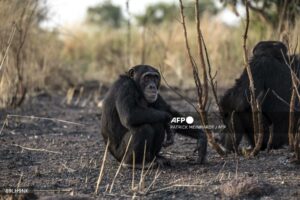
Their unusual lives offer clues as to humans’ own evolutionary past as we migrated to new climates, while their adaptations to the heat feel timely in a world where temperatures are on the rise. (Photo by PATRICK MEINHARDT / AFP)
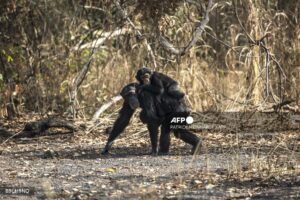
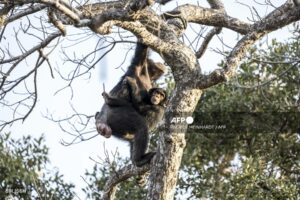
– Gold producer –
The Kédougou region, where the Fongoli savannah is located, is the country’s largest gold producer, accounting for 98% of traditional gold mining sites, according to a 2018 study by the National Agency for Statistics and Demography (ANSD).
It is one of the poorest regions in Senegal, with a poverty rate of over 65%, according to ANSD figures for 2021-2022.
At one of the many mining sites located in the immediate vicinity of these great apes, a large crevice in the earth’s surface leads to a deep underground tunnel where tired, dust-covered men enter and exit. Others work around smaller pits, while a rock-crushing machine noisily crushes the substrate.
More than 30,000 people work in the traditional gold mining sector in Senegal, according to a 2018 ANSD report.
But that number has been steadily increasing in recent years, estimates Aliou Bakhoum, director of a local NGO. The “dioura” can be lucrative for those who discover gold, but it is a matter of “luck,” he says, describing it as dangerous work.
The boom in gold mining since the 2010s has attracted many local residents. However, mining poses new threats to the survival of chimpanzees: increased water pollution, deforestation, and the spread of human diseases.
The Fongoli chimpanzees, now numbering 35, are the first and one of the only groups of savanna chimpanzees to have acclimated to the presence of researchers.
The discoveries made by Jill Pruetz and her team are fascinating: living in the extreme heat of the savanna, these primates have learned to bathe in natural pools, rest in cool caves, and remain calm in the presence of fire.
Dondo “Johnny” Kanté is now the project manager for the study, having worked with Ms. Pruetz since its inception.
Originally from a nearby Bedik village, he believes that integrating local workers helps the wider community to “take an interest in the project.”
He hopes that the involvement of researchers will encourage other residents of the region to “continue to support, protect, and truly work for the well-being” of the Fongoli chimpanzees.
Humaniterre with AFP