Accra, Ghana
By Winnifred Lartey
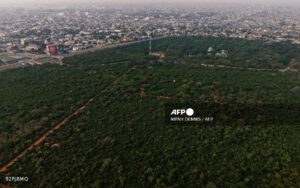
On the outskirts of Accra, the Ghanaian capital, the small 360-hectare forest of Achimota has become an unlikely refuge for people with mental health issues.
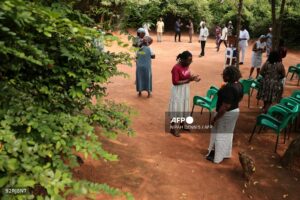
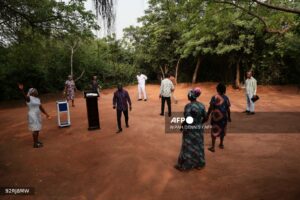
On a typical morning, dozens of patients flock there. Women clutching their Bibles walk silently alongside their children.
The calm at the forest entrance contrasts with the singing, praying, clapping, and wailing that echoes through the clearing.
Some worshippers collapse to the ground, as if seized by invisible forces.
Across the country, prayer camps like this one are welcoming more and more people suffering from depression, anxiety, or psychotic disorders, the prevalence of which has risen sharply since the COVID-19 pandemic, according to the World Health Organization (WHO).
With just over 80 psychiatrists for more than 35 million inhabitants, according to Ghana’s Mental Health Authority (MHA), access to specialized care in Ghana remains very limited, especially in rural areas.
In this country, where more than 70% of the population is Christian and mainly belongs to Pentecostal evangelical churches, stigma hinders the treatment of mental disorders.
A 2022 Afrobarometer survey reveals that 60% of Ghanaians attribute mental illness to witchcraft or curses.
And deep mistrust of hospitals, coupled with hopes for instant miracles, continue to draw thousands of people to evangelical prayer camps across the country.

Depression and anxiety have surged in the wake of Covid-19 in Ghana and Africa as a whole, according to the World Health Organization.
In Ghana, just over 80 psychiatrists serve a population exceeding 35 million people, according to the Mental Health Authority (MHA), a government agency under the Ministry of Health.
Access to clinical care is thin outside major cities. And even as the MHA says more 21 percent of Ghanaians are living with mild to severe mental disorders, only two percent of the national health budget is allocated to mental healthcare.
Families often turn instead to forest “prayer camps” and spiritual healers, driven by beliefs that mental illness is rooted in curses, witchcraft or possession. (Photo by Nipah Dennis / AFP)
(Photo by Nipah Dennis / AFP)
– “Disturbed” –
In the Achimota clearing, Faustina, a pseudonym, aged around 30, stares into space.
Her family says she has been “mentally disturbed” for a month.
Convinced that her illness is spiritual in origin, her relatives brought her to see Elisha Ankrah, “prophet” of the evangelical church The World for Christ.
“She changed overnight. We think it’s a curse. The hospital’s medication takes time, but prayer can work instantly,” says Faustina’s sister, Rita Kumi, kneeling beside her.
Dressed in white, the “prophet” Ankrah insists that prayer and fasting are the main remedies.
“What doctors cannot cure, God can,” he wants to believe.
“Many come here after hospitals have failed them. Through prayer and fasting, they feel rejuvenated,” the cleric continues.
According to health authorities, more than 21% of Ghanaians suffer from mild to severe mental disorders. However, only 2% of the national health budget is devoted to mental health.
About an hour and a half northeast of Accra, at the Mt. Horeb prayer camp in Mamfe, Kingsley Adjei, a faithful follower, is categorical: “You don’t treat spirits with pills, you break them through prayer.”
In Adeiso, about 50 kilometers from the capital, the Pure Power prayer camp also welcomes patients. Augustina Twumasi, who serves as a deacon, believes that these camps relieve pressure on a healthcare system that is at breaking point.
“Without the prayer camps, hospitals would collapse under the number of patients (…) we are helping the state,” she says.

– Chains, fasting –
At Korle Bu University Hospital, the country’s main facility, psychiatrist Abigail Harding emphasizes the weight of religious beliefs.
“Psychological distress or unusual behavior is often interpreted as spiritual—witchcraft, curses, possession—rather than illness,” she explains, which is why patients turn “first to prayer camps rather than hospitals.”
“The problem is that many of these religious facilities are unregulated and lack trained professionals. Some patients are chained, forced to fast, or isolated, which can exacerbate trauma and delay effective treatment,” the psychiatrist laments.
NGOs have also denounced the conditions in which patients find themselves in many of these camps, which are often located in cramped and poorly ventilated premises, where malnourished patients sleep on concrete floors.
Despite Ghana’s 2017 ban on the use of chains for people with psychosocial disorders, the practice has not stopped, according to Human Rights Watch. In 2023, the organization helped free more than 30 chained patients in the eastern region of the country alone.
Ghana’s 2012 Mental Health Act stipulates that no one “shall be subjected to torture, cruelty, or inhuman treatment.”
However, only five of the country’s 16 regions have operational visiting committees to enforce the law.
Clinical psychologist Emmanuel Asampong of the University of Ghana believes that many cases of depression go unnoticed and advocates for collaboration between religious healers and health professionals.
“If they detect signs of danger, they can refer patients to hospitals,” he says.
As the sun rises over the Achimota forest, the prayers intensify. Faustina remains motionless. At her side, her sister squeezes her hand, whispering that healing is near. Maybe not today, but after more fasting.
Humaniterre with AFP
photo credit : Nipah Dennis