Goma, DR Congo
Photos: Jospin Mwisha
In her kitchen, Julienne Mukelenge no longer fears toxic fumes or power outages. This resident of Goma, in eastern DRC, has switched to biogas, a cheaper and less polluting energy source produced by a local company.
In this major city in the eastern Democratic Republic of the Congo (DRC), “electricity is expensive, but with biogas, it’s very economical,” says Julienne Mukelenge, wearing her apron, standing in front of a pot engulfed in large blue flames where she is cooking dinner.
A large portion of Goma’s nearly one million residents are too poor to afford electricity and rely heavily on charcoal, known as “makala,” for their daily needs.
The resurgence of the Rwandan-backed armed group M23 in late 2021 in eastern DRC caused an influx of displaced people to the outskirts of Goma. Several hundred thousand of them crowded into makeshift camps on the city’s outskirts, accelerating deforestation in the neighboring Virunga National Park.
After the M23 seized the city in January 2025, the armed group banned logging in the park in Goma, an activity it claims helps finance militias allied with Kinshasa, driving up the price of bags of charcoal
“I used to buy a bag of charcoal to last a month,” but with “the rising price of a bag, gas is cheaper here,” says Romaine Kanyere, a mother of two.
A 6-kg bottle of biogas, purchased for $8, covers the needs of a household of 3 to 5 people for nearly two weeks, compared to $30 per month with charcoal.

Some people are switching to biogas, a renewable energy source that is cheaper and locally produced.
Biogas is produced by the decomposition of organic matter.
It has been made in Goma since 2016 by Umoja, a local company whose stated aim is to offer an alternative to firewood, which destroys forests. (Photo by Jospin Mwisha / AFP)
– Eco-friendly fertilizer –
Biogas, produced from the decomposition of organic matter, has been manufactured in Goma since 2016 by a local company, Umoja, which aims to offer an alternative to firewood, a major threat to forests.
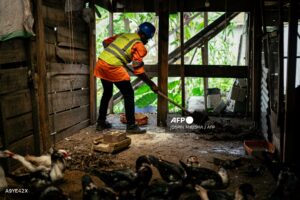
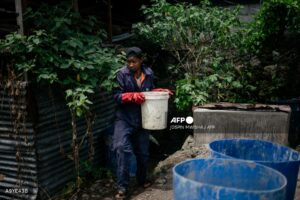
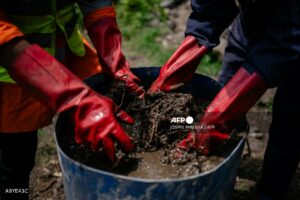
Yves Rubarura, an Umoja employee wearing overalls and protective goggles, collects “thirty cartloads” of manure each week from the company’s chicken coops and those of local partners to fill the “biogas digesters”—concrete pits where the waste is converted into methane before being bottled.
According to him, about fifty of these biogas digesters—which are easy to build and operate—have been constructed in the region by the company, which claims to distribute 720 kg of biogas to its customers each month.
This small-scale production remains limited for now. In Goma, residents lack the space and resources to build their own biogas digesters, according to Victor Materanya, director of the company Umoja. Storage is also an issue, given the lack of suitable tools to pressurize the bottles.
He nevertheless hopes to expand this technology to rural areas, where farmers who supply the compost can then recover the fertilizer produced at the end of the anaerobic digestion process.
Serge Bashonga, an environmentalist in Goma, believes that producing this fertilizer can reduce the use of chemical fertilizers and the environmental damage they cause.
According to him, biogas also helps reduce the “toxic fumes from waste incineration” that poison the air in the capital of North Kivu and the daily lives of its residents.
Humaniterre with AFP