Tawila, Sudan
In the darkness of the container where he was locked up, every thud told Ibrahim Nour el-Din that a fellow prisoner had just collapsed, suffocating to death as Sudanese paramilitaries crammed men inside during their offensive on El-Facher.
Thousands of people are believed to have been captured by the Rapid Support Forces (RSF) — who have been fighting the army since 2023 — during their takeover of the last major city in Darfur still resisting them, in October.
“When people died of thirst or hunger, they beat us to force us to go bury them outside,” says Mr. el-Din, a 42-year-old former detainee.
“They reduced us to forced labor: carrying their luggage, equipment, and weapons. If we were slow, they would whip us,” he confides from Tawila, a refuge town west of El-Facher, where hundreds of thousands of displaced people live.
In February, a UN fact-finding mission reported “acts of genocide” in El-Facher after the city fell into the hands of the FSR. And the UN Human Rights Office, together with the Center for Information Resilience (CIR), also revealed the existence of a vast prison network consisting of hospitals, schools, and shipping containers converted into jails, such as the one where Mr. el-Din nearly died
The FSR now exercises absolute control over El-Facher, described as a “ghost town” by the few aid workers allowed to enter.
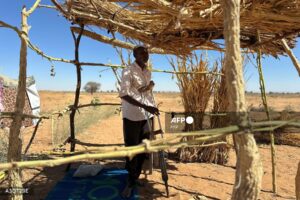
In Tawila, a journalist was able to gather rare accounts from former detainees, who are now taking refuge in makeshift shelters.
– “Sips of Water” –
During the FSR’s assault on El-Facher on October 26, Mr. el-Din and six other men were “beaten and accused of fighting for the army,” explains the survivor, leaning on a crutch, his body marked by his injuries.
Thrown into the back of a pickup truck, he was driven to the al-Borsa market and then locked up with 120 other men in a container, deprived of air.
For more than a month, their survival depended on “tiny sips of water” and “a few lentils.”
Investigations by the UN and the London-based CIR show that civil servants, doctors, journalists, teachers, and aid workers were among the detainees.
Many were held captive for ransom or because of their ethnicity.
An FSR spokesperson stated that these reports were “propaganda,” accusing the army of “using civilians as human shields.”
– “Nails pulled out with pliers” –
One of the main detention centers was the pediatric hospital in El-Facher, where more than 2,000 men were crammed together without food or water.
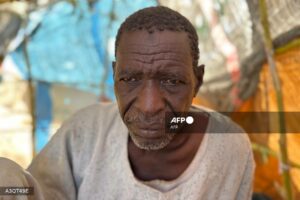
Abdallah Idris, 45, says he was held there for a month. Reduced to drinking nothing but saline solution, he claims to have seen dozens of people die every day.
The UN recorded up to 40 deaths per day at the peak of what appeared to be a cholera outbreak, killing 260 people in a single week.
In addition to the disease, “the torture was horrific, especially for young men,” he adds. “If you tried to speak, they would shoot you.”
Ahmed Aman, another 45-year-old former detainee, reports that some had their “fingernails pulled out with pliers.”
– “Like animals” –
Nedal Yasser, 27, was abducted the day after the FSR assault.
For six weeks, she was shuttled from one detention site to another, passing through al-Mina al-Bary, a bus depot where, according to the UN, hundreds of people were held in about 70 containers.
“I was beaten, tied up, and interrogated. When they found out my husband was a soldier, the torture got worse,” she says. “We were sexually exploited and harassed; we were only allowed to use the bathroom occasionally.”
She and other women were ordered to pay ransoms of $2,000, but everything she owned had “already been looted.”
After being “assaulted” in a house, Ms. Yasser was abandoned in a remote area and walked dozens of kilometers to Tawila, suffering a miscarriage along the way.
After being “assaulted” in a house, Ms. Yasser was abandoned in a remote area and walked dozens of kilometers to Tawila, suffering a miscarriage along the way.
The UN has documented widespread acts of torture and “cruel, inhuman, and degrading treatment,” including sexual violence, beatings with wooden sticks, floggings, and suspension from trees.
In Tawila, the survivors are suffering from the aftereffects of their detention.
Mr. Aman’s back is “in tatters” from the beatings, while Ms. Yasser faints at the slightest exertion.
Ahmed al-Sheikh, a 43-year-old mechanic, is now blind in one eye and limps after being struck by an FSR fighter.
He did not reach a safe place until February, after spending four months in Shala prison, where, according to the UN, the FSR held more than 2,000 prisoners in January.
“They were killing people right in front of us,” he recounted. “They would pick people at random and shoot them down like animals.”
According to the UN, at least 6,000 detainees were transferred from El-Facher to Tagris Prison in Nyala, an FSR stronghold, where there is a total media blackout.
Humaniterre with AFP