Actualité

𝐊𝐞𝐧𝐲𝐚: 𝐋𝐚𝐤𝐞 𝐖𝐚𝐭𝐞𝐫𝐬 𝐑𝐢𝐬𝐞, 𝐋𝐞𝐚𝐯𝐢𝐧𝐠 𝐑𝐞𝐬𝐢𝐝𝐞𝐧𝐭𝐬 𝐚𝐭 𝐭𝐡𝐞 𝐌𝐞𝐫𝐜𝐲 𝐨𝐟 𝐂𝐫𝐨𝐜𝐨𝐝𝐢𝐥𝐞𝐬

Baringo, Kenya


By Mary Kulundu

On the roof of what was once a tourist resort—now almost entirely submerged—a crocodile basks in the sun… As the waters of Lake Baringo in Kenya rise and flood the land, crocodiles and hippos are moving dangerously close to the surrounding homes where thousands of families still live.

Like other lakes in the Rift Valley region, the waters of Lake Baringo—located about 200 km northwest of Nairobi—have reached levels not seen in half a century, a phenomenon scientists attribute to extreme rainfall linked to climate change.

According to the local disaster management authority, tens of thousands of residents living along the shores have already had to be relocated nearby. But some say the lake continues to follow them.

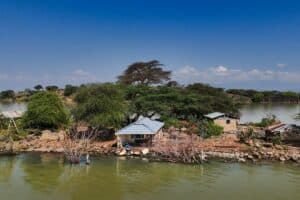
Near a house with water lapping at its doorstep, three more crocodiles are basking.

In 2011, the year of the lake’s first significant flood, a hippopotamus attacked and killed Mary Milka Tiren’s husband as he was returning from the hotel where he worked—a hotel that is now also underwater.

Ten years later, a crocodile attacked her nine-year-old son, who was left with several scars after spending three months in the hospital.

The reptile “was trying to rip his arm off,” but the child was rescued, his mother says.

“There has been an increase in crocodile attacks, not because there are more crocodiles, but because the lake is now close to people’s homes,” explains Jackson Komen, director of the Kenya Wildlife Service (KWS) for the Lake Baringo Protected Area. “There are also hippo attacks, because when the lake expanded, the nearby ecosystem” where these mammals used to graze “disappeared.”
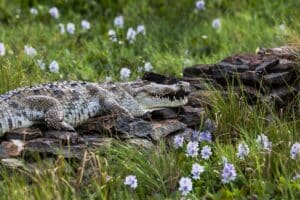


A crocodile perch on a stone hedge around a domestic compound now almost completely inundated in the rising waters of the Lake Bogoria in Marigat sub-county, Baringo county on July 27, 2026. Lake Baringo and other lakes in Kenya’s Rift Valley have risen to levels not seen in at least half a century, with scientists attributing the surge to extreme rainfall linked to climate change. Tens of thousands of people have been displaced to higher ground, according to official disaster management data, yet many victims say the lakes keep following them. (Photo by Tony KARUMBA / AFP)
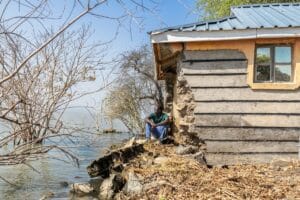
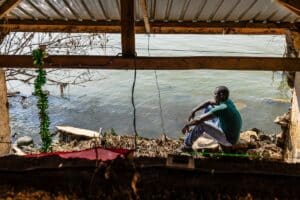
Alfred Lekombe, 29, sits on the water’s edge in the ruins of what was his bedroom now destroyed by the rising Lake Bogoria in Marigat sub-county, Baringo county on July 28, 2026. (Photo by Tony KARUMBA / AFP)
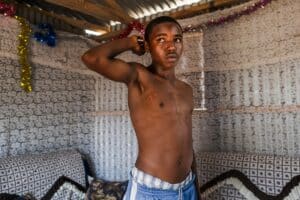
The teenaged son of Mary Milka Tiren, 40, (not pictured) shows scars on his body from a crocodile attack on Lake Bogoria, a decade after he lost his father to another attack by a Hippopotamus in the wake of increased proximity of wildlife to human settlements around the rising lake in Marigat sub-county, Baringo county on July 28, 2026. Lake Baringo and other lakes in Kenya’s Rift Valley have risen to levels not seen in at least half a century, with scientists attributing the surge to extreme rainfall linked to climate change. Tens of thousands of people have been displaced to higher ground, according to official disaster management data, yet many victims say the lakes keep following them. (Photo by Tony KARUMBA / AFP)

– “Ecological Disaster” –

Analysis of satellite imagery shows that Lake Baringo’s surface area has grown by 70% since 2010, increasing from 138 to 234 km² by 2026. At the same time, nearby Lake Bogoria has expanded by 21%, growing from 34 to 41 km².

The shores of the two lakes are now barely 10 km apart. And scientists now fear an “ecological disaster” if they merge and the freshwater of Baringo mixes with the highly saline and alkaline water of Bogoria.

Jackson Komen fears a “complete” and unpredictable change in the ecosystems. “If the two lakes mix, fish, crocodiles, and hippos might not survive,” he adds, predicting “an ecological disaster that we don’t know how to manage.”

“I don’t know if humans will be able to continue living here,” he emphasizes, noting that Baringo provides drinking water and irrigation water and supports a thriving fishing industry.
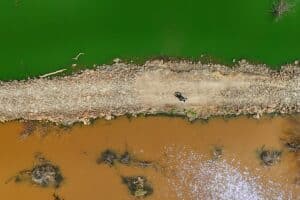
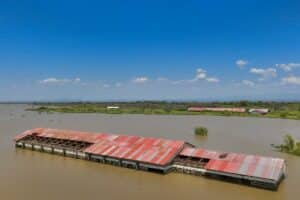
An aerial image (Photo by Tony KARUMBA / AFP)
Alfred Lekombe, 29, sits on the water’s edge in the ruins of what was his bedroom now destroyed by the rising Lake Bogoria in Marigat sub-county, Baringo county on July 28, 2026. (Photo by Tony KARUMBA / AFP)
Lake Baringo and other lakes in Kenya’s Rift Valley have risen to levels not seen in at least half a century, with scientists attributing the surge to extreme rainfall linked to climate change. Tens of thousands of people have been displaced to higher ground, according to official disaster management data, yet many victims say the lakes keep following them. (Photo by Tony KARUMBA / AFP)

Some experts believe that “overflow is already underway” between the two lakes.

” “Satellite elevation data show that Lake Bogoria’s water level is high enough for it to flow into Lake Baringo,” says Mathew Herrnegger, a researcher at the Institute of Hydrology and Water Management at the University of Natural Resources and Life Sciences in Vienna (Austria), adding that the amount of water likely to flow out and its potential impact remain uncertain.

– “Helpless” –

The rising waters of the two lakes have also severely affected the tourism sector. Approximately “80% of the community-managed nature reserves have disappeared” under the water, notes Jackson Komen, forcing the relocation of giraffes, ostriches, warthogs, and impalas to other areas.

Journalists have seen four hotel complexes now barely emerging from Lake Baringo. Another, empty, lies abandoned on an island.

The flooding of Lake Bogoria has driven away some of the millions of flamingos for which it was famous and engulfed its famous hot-water geysers.

Annual tourism revenue has fallen to one-fifth of its former level and now amounts to only about 200,000 euros, according to Michael Baimet, director of local disaster management services. Online, visitors complain about the low number of flamingos at Lake Bogoria and the impassable roads due to flooding.

Twelve schools on the shores of Baringo and Bogoria are partially or completely submerged, according to official figures.

On Kokwa Island, in the middle of Lake Baringo, water has submerged the fence separating the lake from the girls’ dormitory at the elementary school.

“It’s dangerous for the boarders, with hippos and crocodiles roaming the school grounds at night,” explains a school official who requested anonymity. “We’ve had to hire two security guards.”

The school fears that the heavy rains expected with the El Niño weather phenomenon in October will flood the dormitory.

The island’s residents know that a move is inevitable, but are delaying the decision due to the cost.

Around her plot of land—which used to be one hectare—Faith Mpayei has already moved her fence twice since 2016. But it is submerged once again, and the water continues to advance toward her home.

“We’re helpless,” says this mother of five. “I have to move (…) there’s nothing left to do here.”

Humaniterre with AFP

Download

the online magazine

Similar items

Port-au-Prince, Haiti Armed gangs have swept through neighborhoods north of Haiti’s capital, forcing more than 5,000 to leave their homes

Pas de pauvreté

Éliminer la pauvreté sous toutes ses formes et partout dans le monde.

No poverty

End poverty in all its forms and everywhere.

Faim«zero»

Éliminer la faim, assurer la sécurité alimentaire, améliorer la nutrition et promouvoir l’agriculture durable.

Zero hunger

Éliminer la faim, assurer la sécurité alimentaire, améliorer la nutrition et promouvoir l’agriculture durable.

Bonne santé et bien-être

Assurer une vie saine et promouvoir le bien-être pour tous à tout âge.

Good health and well-being

Ensure healthy lives and promote well-being for all at all ages

Education de qualité

Assurer une éducation de qualité exclusive et équitable et promouvoir les possibilités d’apprentissage tout au long de la vie pour tous.

Quality education

Ensure exclusive and equitable  quality education and promote lifelong learnig opportunities for all.

égalité entre les sexes

Assurer l’égalité des sexes et l’autonomisation de toutes les femmes et les filles.

Gender equality

Achieve gender equality and empower all women and girls.

Eau propre et assainissement

Assurer la disponibilité et la gestion durable de l’eau et de l’assainissement pour tous.

Clean water and sanitation

Ensure availability and sustainable management of water and sanitation for all.

Energie propre et D’un coût abordable

Assurer l’accès à une énergie abordable, fiable, durable et moderne pour tous.

Affordable and clean energy

Ensure access to affordable, reliable, sustainable and modern energy for all.

Travail décent et croissance économique

Promouvoir une croissance économique soutenue, inclusive et durable, le plein emploi productif et un travail décent pour tous.

Decent work and economic growth

Promote sustained, inclusive and sustainable economic growth, full and productive employment and decent work for all.

Industrie, innovation et infrastructure

Construire des infrastructures résilientes, promouvoir une industrialisation inclusive et durable et encourager l’innovation.

Industry, innovation and infrastructure

Build resilient infrastructure, promote inclusive and sustainable industrialization and foster innovation.

Inégalités réduites

Réduire les inégalités entre les pays et au sein des pays.

Reduced inequalities

Reduce inequalities among and within countries.

Ville et communautés durables

Rendre les villes et les établissements humains inclusifs, sûrs, résiliants et durables.

Sustainable cities and communities

Make cities and human settlements inclusive, safe, resilient and sustainable.

Consommation et production responsable

Assurer des modes de consommation et de production durables.

Responsible consumption and production

Ensure sustainable consumption and production patterns.

Mesure relatives à la lutte contre les changements climatiques

Prendre des mesures urgentes pour lutter contre le changement climatique et ses impacts.

Climate action

Take urgent action to combat climate change and its impacts.

Vie aquatique

Conserver et utiliser durablement les océans, les mers et les ressources marines pour le développement durable.

Life below water

Conserve ans sustainably use the oceans, seas and marine resources for sustainable development.

Vie Terrestre

Protéger, restaurer et promouvoir l’utilisation durable des écosystèmes terrestres, gérer durablement les forêts, lutter contre la désertification, stopper et inverser la dégradation des sols et mettre un terme à la perte de biodiversité.

Life on land

Protect, restore and promote sustainable use of terrestrial ecosystems, sustainably manage forests, combat desertification and halt and reverse land degradation and halt biodiversity loss.

Paix, justice et institutions efficaces

Promouvoir des sociétés pacifiques et inclusives pour le développement durable, assurer l’accès à la justice pour tous et mettre en place des institutions efficaces, responsables et inclusives à tous les niveaux.

Peace, justice, and strong institutions

Promote peaceful and inclusive societies for sustainable development, provide access to justice for all and build effective, accountable and inclusive institutions at all levels.

Partenariats pour la réalisation des Objectifs

Renforcer les moyens de mise en œuvre et revitaliser le partenariat mondial pour le développement durable.

Partnerships for the goals

Strenghen the means of implementation and revitalize the global partnership for sustainable development.